
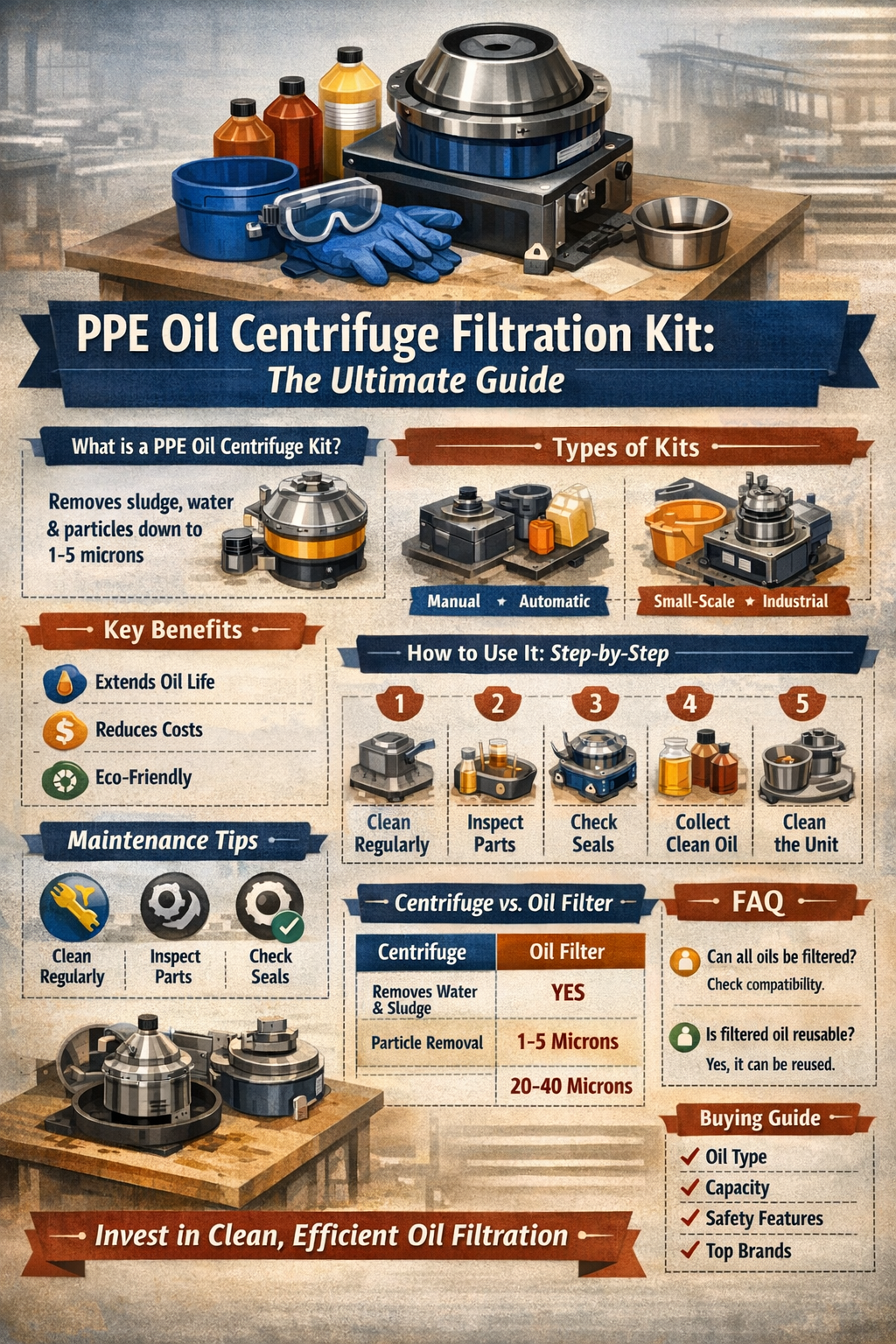
When it comes to maintaining the quality and longevity of industrial oils, a PPE Oil Centrifuge Filtration Kit is one of the most effective tools available. Unlike standard oil filters, these kits utilize centrifugal force to remove water, sludge, and microscopic impurities, ensuring that machinery runs smoothly and efficiently. Whether you’re operating heavy industrial equipment, generators, or automotive systems, understanding how to choose, use, and maintain a centrifuge filtration kit can save both time and money.
What is a PPE Oil Centrifuge Filtration Kit?
A PPE Oil Centrifuge Filtration Kit is a specialized system designed to purify and filter oil using centrifugal force. The kit usually includes the centrifuge unit, collection bowls, safety PPE (like gloves and goggles), and sometimes additional filtration cartridges depending on the model.
Definition and Components
At its core, the kit consists of:
- Centrifuge bowl and rotor – Spins at high speeds to separate contaminants.
- Collection containers – Capture clean oil and separate sludge or water.
- Safety equipment – Gloves, goggles, and aprons for safe operation.
- Filters or cartridges – Optional, for additional fine filtration.
This setup allows operators to remove microscopic particles, sludge, and water from oils such as diesel, hydraulic, transformer, or engine oils. Unlike conventional filters that rely on mesh or paper, the centrifuge can filter impurities down to 1–5 microns, dramatically improving oil quality.
How Does an Oil Centrifuge Work?
The centrifugal filtration process relies on the principle of density separation. When the centrifuge spins at high speeds:
- Heavier particles (sludge, dirt, and metal fragments) move outward and settle at the bowl’s edge.
- Water droplets are forced to the perimeter due to their density.
- Clean oil collects in the center and can be safely reused.
This method is highly efficient, removing contaminants that standard oil filters often miss. It not only improves the performance of machinery, but also extends the service life of the oil, reducing waste and operational costs.
Types of PPE Oil Centrifuge Filtration Kits
Choosing the right PPE Oil Centrifuge Filtration Kit depends on your oil type, volume requirements, and operational environment. Not all kits are created equal, and understanding the different types and features can help you select the most efficient system for your needs.
Manual vs. Automatic Centrifuge Kits
Manual centrifuge kits require operators to monitor and adjust the process, typically involving hand-start mechanisms or simple control panels. These are ideal for small-scale operations, workshops, or laboratories where oil volume is limited.
Automatic centrifuge kits, on the other hand, come with programmable controls that regulate speed, run time, and collection cycles. They are perfect for industrial or high-volume applications, reducing human error and labor costs.
Comparison Table: Manual vs. Automatic Centrifuge Kits
| Feature | Manual Centrifuge Kit | Automatic Centrifuge Kit |
|---|---|---|
| Ease of Use | Moderate, operator required | High, automated process |
| Oil Volume Capacity | Low to medium | Medium to high |
| Maintenance | Simple | Slightly more complex |
| Cost | Lower | Higher |
| Ideal Use Case | Workshops, labs | Industrial plants, large operations |
Industrial vs. Small-Scale Kits
Industrial PPE oil centrifuge kits are designed to handle large volumes of oil efficiently, often exceeding hundreds of liters per hour. They are commonly used in factories, power plants, and marine engines, where continuous operation is essential.
Small-scale kits are compact and portable, suitable for maintenance garages, small businesses, and research labs. They are easy to store and operate but may require more frequent runs to process large oil volumes.
Key Features to Look For
When selecting a PPE oil centrifuge filtration kit, consider these important features:
- Filtration Efficiency: Look for kits that remove particles as small as 1–5 microns. Higher efficiency results in cleaner oil and less wear on machinery.
- Oil Compatibility: Ensure the kit supports the specific oils you use—engine, hydraulic, transformer, or cooking oils.
- Throughput Capacity: Match the kit’s processing rate to your operational needs to avoid bottlenecks.
- Safety Features: Kits should include automatic shutdowns, overload protection, and proper PPE guidance to prevent accidents.
- Ease of Maintenance: Rotors and bowls should be easy to clean, and parts should be replaceable without professional assistance.
By understanding the types of PPE oil centrifuge filtration kits, you can make a smart choice that balances cost, efficiency, and operational requirements. Whether you need a small manual kit for occasional oil filtration or a high-capacity automatic system for industrial use, the right selection ensures maximum oil longevity and equipment protection.
Benefits of Using a PPE Oil Centrifuge Filtration Kit
Using a PPE Oil Centrifuge Filtration Kit offers numerous advantages over conventional oil filters, making it an essential tool for industries that rely on clean, high-performance oils. Below are the main benefits that make these kits a worthwhile investment.
Improved Oil Quality
One of the most significant benefits is dramatically improved oil quality. The centrifugal action removes:
- Microscopic particles like metal shavings, carbon residues, and dirt.
- Water content that can cause corrosion or reduce oil efficiency.
- Sludge and sediments that accumulate over time in machinery.
By eliminating these impurities, the filtered oil maintains its chemical and thermal properties, ensuring machinery operates efficiently and safely. Studies show that centrifugal filtration can extend oil life by up to 3–5 times compared to standard filtration methods.
Cost Efficiency
Investing in a PPE oil centrifuge kit can result in significant cost savings:
- Reduced oil replacement frequency – Clean oil lasts longer, decreasing procurement costs.
- Lower maintenance expenses – Equipment suffers less wear and tear from contaminated oil.
- Decreased downtime – Machines operate smoothly, avoiding costly repairs or operational delays.
For example, an industrial plant using a high-volume centrifuge kit reported saving over $15,000 annually in oil and maintenance costs alone.
Environmental Benefits
Centrifugal oil filtration also provides environmental advantages:
- Less oil waste – Reusing filtered oil reduces the need for disposal and lowers environmental impact.
- Reduced chemical contamination – Prevents heavy metals and particulates from entering wastewater systems.
- Sustainable operations – Helps companies meet environmental compliance and green initiatives.
By filtering and reusing oil, organizations can significantly reduce their carbon footprint and contribute to sustainable industrial practices.
Enhanced Equipment Performance
Clean oil ensures machines run smoothly and efficiently, leading to:
- Reduced friction and wear on moving parts.
- Consistent thermal management, preventing overheating.
- Extended machinery lifespan – Prevents premature failures due to sludge or contaminants.
Case studies have shown that machinery operating with centrifugally filtered oil experiences up to 30% fewer breakdowns compared to equipment using unfiltered or conventionally filtered oil.
How to Use a PPE Oil Centrifuge Filtration Kit
Using a PPE Oil Centrifuge Filtration Kit properly ensures maximum efficiency, safety, and longevity of both your oil and machinery. While the process may seem technical, it’s straightforward once you understand the steps and best practices.
Step-by-Step Guide
Here’s a practical step-by-step process for using a centrifuge oil filtration kit:
- Prepare the Equipment
- Ensure the centrifuge is clean and assembled correctly.
- Place collection containers for clean oil and sludge.
- Check that the rotor and bowl are securely in place.
- Prepare the Oil
- Pre-filter the oil if it contains large debris to prevent damage to the centrifuge.
- Pour the oil into the centrifuge’s feeding inlet slowly.
- Operate the Centrifuge
- Start the centrifuge at the recommended speed.
- Allow it to spin for the required duration based on oil volume and contamination level.
- Monitor the process; some automatic kits regulate speed and timing, while manual kits require observation.
- Collect the Filtered Oil
- Once filtration is complete, carefully remove the clean oil from the collection container.
- Dispose of sludge and water according to local regulations.
- Clean the Centrifuge
- Remove any residual sludge and clean the rotor and bowl.
- Ensure the equipment is dry and ready for the next use.
Safety Tips While Using the Kit
Operating a centrifuge involves high-speed rotation, so safety is crucial:
- Always wear PPE: gloves, goggles, and aprons.
- Never open the centrifuge while it’s spinning.
- Ensure the equipment is on a stable, level surface.
- Keep hands and loose clothing away from moving parts.
Common Mistakes to Avoid
Even with the best equipment, mistakes can reduce efficiency or cause damage:
- Overloading the centrifuge – Can strain the motor or reduce filtration efficiency.
- Neglecting regular cleaning – Leads to residue buildup and reduced performance.
- Using incompatible oils – Some centrifuges are designed for specific oil types; using the wrong oil can damage the kit.
- Ignoring safety procedures – Could result in accidents or contamination.
Proper usage not only maximizes filtration efficiency, but also extends the lifespan of both the oil and the centrifuge kit, ensuring a cost-effective and safe operation.
Maintenance and Care of Your PPE Oil Centrifuge Kit
Proper maintenance is essential to ensure your PPE Oil Centrifuge Filtration Kit continues to operate at peak efficiency. Neglecting routine care can lead to reduced filtration performance, equipment damage, and safety risks.
Regular cleaning prevents sludge buildup and ensures smooth operation:
- Turn Off and Disconnect – Always power down and unplug the centrifuge before maintenance.
- Remove Residual Oil and Sludge – Carefully dispose of sludge and water according to local regulations.
- Clean the Rotor and Bowl – Use a soft cloth or brush with mild detergent to remove deposits. Avoid abrasive materials that could scratch surfaces.
- Rinse and Dry – Rinse components with clean oil or water (depending on manufacturer instructions), then dry completely to prevent corrosion.
- Inspect Seals and O-Rings – Check for wear or cracks and replace if necessary.
Pro Tip: Cleaning after every use keeps the centrifuge efficient and prevents long-term damage to internal components.
Troubleshooting Common Issues
Even with proper care, minor issues can arise:
| Issue | Possible Cause | Solution |
|---|---|---|
| Reduced filtration efficiency | Rotor or bowl buildup | Thoroughly clean components |
| Excessive vibration or noise | Imbalanced rotor or uneven loading | Rebalance or redistribute oil volume |
| Centrifuge won’t start | Electrical or motor issue | Check power supply, motor, and fuses |
| Oil leaks | Worn seals or O-rings | Replace seals and inspect assembly |
Regular inspection allows early detection and avoids costly repairs.
Recommended Maintenance Schedule
Following a structured maintenance schedule helps maximize performance and longevity:
- Daily: Clean external surfaces, check oil feed, and remove debris.
- Weekly: Inspect rotor, bowl, seals, and fasteners; lubricate moving parts if needed.
- Monthly: Deep clean internal components, check electrical connections, and run test cycles.
- Annually: Full inspection and service by a professional or manufacturer, including replacement of worn parts.
By adhering to these practices, you can ensure your centrifuge kit continues to deliver optimal oil filtration, extend its lifespan, and protect your investment.
Buying Guide for PPE Oil Centrifuge Filtration Kits
Selecting the right PPE Oil Centrifuge Filtration Kit requires careful consideration of several factors. Choosing the wrong kit can lead to inefficient filtration, increased maintenance costs, and shortened equipment lifespan. This guide will help you make the best choice based on your needs.
Factors to Consider Before Purchase
- Oil Type Compatibility
- Not all centrifuge kits work with every oil type. Ensure your kit is compatible with engine, hydraulic, transformer, or industrial oils you intend to filter.
- Throughput Capacity
- Check the kit’s processing rate (liters per hour). High-volume operations need high-capacity centrifuges to avoid delays.
- Filtration Efficiency
- Look for kits that remove particles as small as 1–5 microns for the cleanest oil possible.
- Ease of Use
- Manual kits require more attention and effort, while automatic kits offer convenience, programmable settings, and reduced labor.
- Maintenance Requirements
- Consider ease of cleaning, availability of spare parts, and recommended service intervals.
- Safety Features
- Features like automatic shutdown, overload protection, and PPE guidance are essential for safe operation.
Top Brands and Models
Several brands dominate the PPE oil centrifuge market, offering reliable and efficient filtration solutions. Examples include:
| Brand / Model | Key Features | Ideal Use Case |
|---|---|---|
| Alfa Laval Oil Purifier | High efficiency, automatic, large capacity | Industrial plants, power stations |
| Westfalia Separator | Durable, modular, easy maintenance | Heavy machinery, marine engines |
| Redd Centrifuge Systems | Compact, cost-effective, versatile | Workshops, small-scale labs |
Tip: Always compare features, warranty, and customer reviews before investing. A higher upfront cost may save more in long-term oil and equipment maintenance.
Price Range and Value for Money
- Small-scale kits: $500 – $2,500
- Ideal for workshops or labs; low oil throughput but portable.
- Medium industrial kits: $3,000 – $10,000
- Suitable for mid-volume operations; automatic options available.
- High-capacity industrial kits: $10,000 – $50,000+
- Designed for continuous operation, large factories, or power plants.
While budget kits may suffice for occasional filtration, investing in a high-efficiency, reliable kit provides better long-term value by reducing oil waste, maintenance, and downtime.
PPE Oil Centrifuge Filtration Kit vs. Traditional Oil Filters
While traditional oil filters are common and inexpensive, a PPE Oil Centrifuge Filtration Kit offers superior performance in several critical areas. Understanding the differences can help businesses make smarter choices for oil maintenance.
H3: Efficiency Comparison
| Feature | PPE Oil Centrifuge Kit | Traditional Oil Filter |
|---|---|---|
| Particle Removal | 1–5 microns | 20–40 microns |
| Water and Sludge Removal | Yes | Limited |
| Continuous Filtration Capability | High, can run continuously | Limited to oil flow through filter |
| Oil Reuse | Yes, oil can be cleaned and reused | Typically discarded after use |
Centrifuge kits can remove microscopic impurities, sludge, and water, whereas traditional filters mostly catch larger particles. This results in cleaner oil, better machine performance, and longer oil life.
Cost and Longevity Comparison
Although the initial cost of a PPE centrifuge kit is higher, it provides long-term savings:
- Oil longevity: Centrifuged oil can last 3–5 times longer than unfiltered or conventionally filtered oil.
- Reduced maintenance: Equipment experiences less wear, lowering repair costs.
- Environmental savings: Less oil disposal reduces waste management costs.
In contrast, traditional filters are cheap upfront but require frequent replacement and can’t reclaim oil, leading to higher ongoing costs.
Best Use Cases for Each Method
- PPE Oil Centrifuge Filtration Kit:
- Industrial plants with high oil volume
- Machinery where oil quality is critical (generators, transformers, hydraulic systems)
- Operations aiming for sustainability and cost efficiency
- Traditional Oil Filters:
- Small engines and vehicles with limited oil volume
- Situations where budget constraints outweigh efficiency
- Temporary or low-use equipment where frequent oil changes are acceptable
Summary: For businesses that rely on industrial machinery or high-quality oil performance, a PPE oil centrifuge filtration kit is the superior choice, offering unmatched efficiency, cost savings, and oil longevity compared to traditional filters.
Frequently Asked Questions (FAQs)
Here are some of the most common questions about PPE Oil Centrifuge Filtration Kits, along with detailed answers to help you make informed decisions.
What is the difference between a PPE oil centrifuge and a standard oil filter?
A PPE oil centrifuge filtration kit uses centrifugal force to remove microscopic particles, sludge, and water from oil, achieving 1–5 micron filtration efficiency. Traditional oil filters primarily use mesh or paper to trap larger particles (20–40 microns) and cannot effectively remove water or sludge. This makes centrifuges far more efficient for industrial or high-demand applications.
Can I filter any type of oil with this kit?
Most PPE oil centrifuge kits are compatible with engine oils, hydraulic oils, transformer oils, and some industrial oils, but it’s essential to check the manufacturer’s specifications. Using incompatible oils may damage the centrifuge or reduce filtration efficiency.
How often should the kit be maintained?
- Daily: Clean external surfaces and remove large debris.
- Weekly: Inspect rotor, bowl, and seals.
- Monthly: Deep clean internal components and check electrical connections.
- Annually: Full professional service, including replacement of worn parts.
Regular maintenance ensures optimal performance, safety, and longevity.
H Is the kit safe to use without professional training?
While the kit is designed for ease of use, basic training or careful reading of the manual is recommended. Always wear PPE (gloves, goggles, aprons), follow safety protocols, and never open the centrifuge while it is spinning. Automatic kits reduce operator intervention, but safety precautions remain essential.
How much oil can it process in one hour?
Processing capacity depends on the model:
- Small-scale kits: 10–50 liters per hour
- Medium industrial kits: 100–300 liters per hour
- High-capacity industrial kits: 500+ liters per hour
Always match the kit’s throughput to your operational requirements for maximum efficiency.
Can centrifuged oil be reused safely?
Yes! One of the main benefits of a PPE oil centrifuge filtration kit is that it restores oil quality to near-new condition. Filtered oil can be safely reused in machinery, reducing waste, replacement costs, and environmental impact.
Conclusion
A PPE Oil Centrifuge Filtration Kit is an indispensable tool for any operation that relies on high-quality oil, whether it’s industrial machinery, generators, or automotive systems. By utilizing centrifugal force, these kits remove microscopic particles, sludge, and water that standard filters often miss, ensuring that oil remains clean, efficient, and long-lasting.
Investing in a centrifuge kit offers multiple advantages:
- Improved oil quality – Removes impurities to maintain chemical and thermal properties.
- Cost savings – Reduces oil replacement frequency and lowers maintenance costs.
- Environmental benefits – Minimizes oil waste and supports sustainable practices.
- Enhanced equipment performance – Prolongs machinery lifespan and prevents breakdowns.
Whether you choose a manual small-scale kit for a workshop or a high-capacity automatic kit for industrial operations, the right centrifuge filtration system can dramatically improve operational efficiency and reduce long-term costs.