
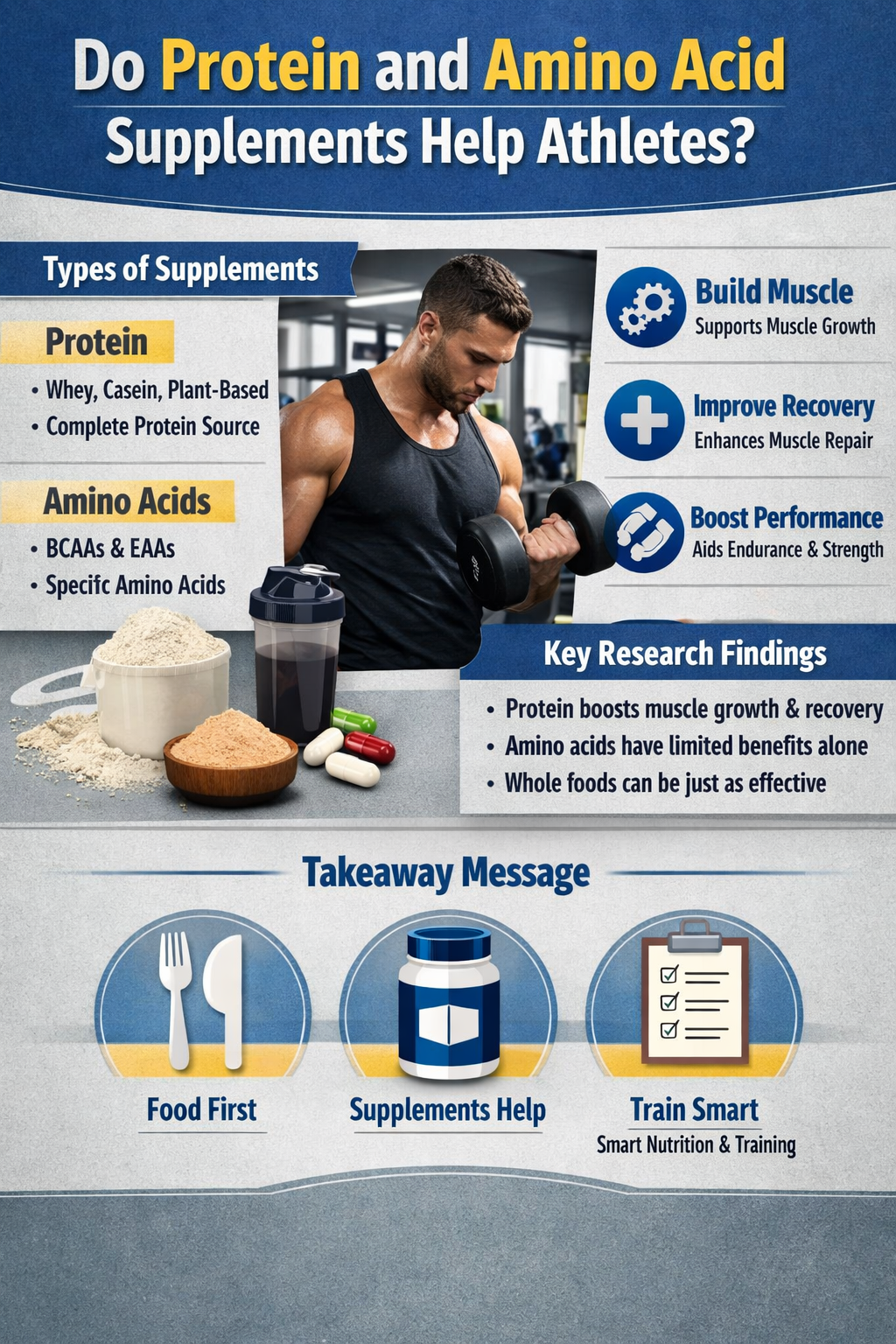
Introduction: Do Protein and Amino Acid Supplements Help Athletes?
Protein and amino acid supplements have become almost synonymous with athletic performance. Walk into any gym, locker room, or sports nutrition store and you’ll see shelves filled with whey protein powders, BCAA drinks, essential amino acid capsules, and recovery shakes. From elite professional athletes to recreational gym-goers, many people believe these supplements are essential for strength, endurance, and faster recovery.
But this leads to an important and often misunderstood question:
Do protein and amino acid supplements actually help athletes, or are they simply convenient additions to an already adequate diet?
This question matters because athletes place unique physical demands on their bodies. Training causes muscle breakdown, increases energy needs, and stresses joints, connective tissue, and the nervous system. Nutrition plays a central role in how well the body adapts to this stress. Protein and amino acids are especially important because they directly support:
- Muscle repair and muscle growth
- Recovery between training sessions
- Maintenance of lean body mass
- Immune system function
- Long-term athletic performance
However, scientific research consistently shows that supplements are not magic solutions. Their effectiveness depends on several factors, including:
- Overall dietary protein intake
- Type of sport (strength, endurance, or mixed)
- Training volume and intensity
- Timing and dosage of intake
- Individual goals and physiology
“Supplements should supplement a good diet — not replace it.”
— Widely accepted principle in sports nutrition research
- What protein and amino acid supplements are
- How they work inside the body
- Whether they truly help athletic performance and recovery
- When supplements are beneficial — and when they are unnecessary
- How athletes can use protein and amino acid supplements effectively and safely
Understanding the Basics: What Are Proteins and Amino Acids?
To understand whether protein and amino acid supplements help athletes, it’s essential to first understand what proteins and amino acids are and how they function inside the body. Many supplement claims sound impressive, but they only make sense when viewed through basic human physiology and nutrition science.
What Is Protein and Why Is It Important for Athletes?
Protein is a macronutrient made up of smaller units called amino acids. These amino acids are often referred to as the building blocks of life because they are involved in nearly every biological process related to growth, repair, and maintenance of body tissues.
For athletes, protein plays several critical roles:
- Repairs muscle damage caused by training
- Stimulates muscle protein synthesis, the process of building new muscle tissue
- Supports enzymes and hormones involved in metabolism and recovery
- Maintains lean muscle mass, especially during intense training or calorie deficits
When athletes train, they create micro-tears in muscle fibers. This damage is normal and necessary for adaptation. Protein provides the raw materials the body needs to repair this damage and rebuild muscle stronger than before.
Key fact: Without adequate protein intake, training adaptations are limited — regardless of how intense the workout is.
What Are Amino Acids?
Amino acids are the individual compounds that link together to form protein. There are 20 amino acids that the human body uses to build proteins, and they are classified into three main categories:
1. Essential Amino Acids (EAAs)
These cannot be produced by the body and must come from food or supplements.
Examples include:
- Leucine
- Isoleucine
- Valine
- Lysine
- Methionine
Essential amino acids are particularly important for athletes because they are directly involved in muscle repair and growth.
2. Non-Essential Amino Acids
These amino acids can be made by the body, even if dietary intake is low.
Examples include:
- Alanine
- Glutamine
- Asparagine
While labeled “non-essential,” they still play important roles in recovery and immune function.
3. Branched-Chain Amino Acids (BCAAs)
BCAAs are a subgroup of essential amino acids:
- Leucine
- Isoleucine
- Valine
They are popular in sports supplements because they are metabolized directly in muscle tissue and are strongly linked to muscle protein synthesis, especially leucine.
Protein vs. Amino Acid Supplements: What’s the Difference?
Many athletes wonder whether they should choose protein supplements or amino acid supplements. Understanding the difference is key.
| Feature | Protein Supplements | Amino Acid Supplements |
|---|---|---|
| Composition | Complete protein (all amino acids) | Individual or grouped amino acids |
| Digestion | Slower, sustained release | Rapid absorption |
| Muscle building | Strong evidence | Mixed evidence |
| Convenience | Meal replacement or post-workout | Intra-workout or fasted training |
| Cost effectiveness | Generally more affordable | Often more expensive |
Protein supplements (like whey or plant protein) provide all essential amino acids in one serving. Amino acid supplements, on the other hand, isolate specific amino acids, often BCAAs or EAAs.
Important insight: If total protein intake is already sufficient, amino acid supplements may offer little additional benefit for most athletes.
How Much Protein Do Athletes Actually Need?
Protein needs vary by sport and training load, but research suggests athletes require more protein than sedentary individuals.
General protein recommendations for athletes:
- Endurance athletes: 1.2–1.6 g per kg of body weight
- Strength & power athletes: 1.6–2.2 g per kg of body weight
- Athletes in calorie deficits: Up to 2.4 g per kg
Example:
A 75 kg (165 lb) athlete training for strength may need 120–165 grams of protein per day.
This raises an important point:
If athletes can meet these targets through food, supplements are optional, not mandatory.
Key Takeaway from the Basics
Protein and amino acids are essential for athletic performance and recovery, but supplements are simply concentrated sources of these nutrients. They are tools — not shortcuts.
Understanding these fundamentals helps us answer the bigger question:
Do protein and amino acid supplements help athletes beyond a normal diet?
continue
Types of Protein and Amino Acid Supplements for Athletes
Now that we understand what protein and amino acids are, the next step is exploring the different types of protein and amino acid supplements athletes commonly use. Not all supplements are the same, and their benefits can vary depending on digestion speed, amino acid profile, training style, and individual needs.
Understanding these differences is essential when evaluating whether protein and amino acid supplements help athletes in real-world situations.
Types of Protein Supplements for Athletes
Protein supplements are designed to provide a convenient, concentrated source of complete protein. They differ mainly in source, digestion rate, and amino acid composition.
Whey Protein
Whey protein is the most researched and widely used protein supplement among athletes.
Key characteristics:
- Derived from milk
- Fast-digesting
- Rich in essential amino acids and leucine
- Highly bioavailable
Benefits for athletes:
- Rapid stimulation of muscle protein synthesis
- Effective for post-workout recovery
- Strong evidence for strength and muscle gains
Research insight: Whey protein consistently outperforms many other protein sources in stimulating muscle protein synthesis due to its high leucine content.
Casein Protein
Casein protein is also derived from milk but digests much more slowly than whey.
Key characteristics:
- Slow, sustained amino acid release
- Forms a gel in the stomach
- Ideal for long periods without food
Benefits for athletes:
- Reduces muscle protein breakdown overnight
- Supports recovery during sleep
- Useful before bed or long breaks between meals
Plant-Based Protein Supplements
Plant-based proteins are increasingly popular, especially among vegan and vegetarian athletes.
Common sources include:
- Pea protein
- Soy protein
- Rice protein
- Hemp protein
Pros:
- Suitable for plant-based diets
- Digestive-friendly for lactose intolerance
- Environmentally sustainable options
Cons:
- Some lack one or more essential amino acids
- Often lower in leucine (unless blended)
Best practice: Blended plant proteins (e.g., pea + rice) provide a more complete amino acid profile for athletes.
Types of Amino Acid Supplements for Athletes
Amino acid supplements isolate specific amino acids rather than providing a full protein source. They are often marketed for performance, endurance, and recovery.
Branched-Chain Amino Acids (BCAAs)
BCAAs include:
- Leucine
- Isoleucine
- Valine
Claimed benefits:
- Reduced muscle soreness
- Improved recovery
- Enhanced endurance
What the science says:
- BCAAs alone do not stimulate muscle growth without other essential amino acids.
- Benefits are most noticeable when total protein intake is low.
Key takeaway: BCAAs are inferior to complete protein for muscle building.
Essential Amino Acids (EAAs)
EAAs contain all nine essential amino acids required for muscle protein synthesis.
Benefits for athletes:
- Faster absorption than whole protein
- Can stimulate muscle protein synthesis
- Useful during fasted training or limited appetite
Limitation:
- Typically more expensive than protein powder
- Still less effective than whole protein over time
Individual Amino Acids
Some athletes supplement with single amino acids, such as:
- Glutamine (immune support)
- Arginine (blood flow)
- Beta-alanine (endurance buffering)
While these may support specific performance aspects, they do not replace dietary protein.
Comparison: Protein vs Amino Acid Supplements
| Factor | Protein Supplements | Amino Acid Supplements |
|---|---|---|
| Completeness | Full amino acid profile | Partial or specific |
| Muscle growth | Strong evidence | Limited alone |
| Recovery | Proven benefits | Context-dependent |
| Cost | More affordable | Often expensive |
| Best use | Daily intake & post-workout | Fasted or endurance training |
Key Takeaway from Supplement Types
Protein supplements are more effective and evidence-backed for most athletes. Amino acid supplements may have specific niche uses, but they are not superior to protein when total intake is adequate.
How Protein and Amino Acid Supplements Help Athletes
This section addresses the core search intent behind the question:
Do protein and amino acid supplements help athletes improve performance, recovery, and muscle growth?
To answer this properly, we need to look at how these supplements affect the body during and after training, and what the scientific evidence actually shows.
Muscle Protein Synthesis and Muscle Growth
One of the primary reasons athletes use protein and amino acid supplements is to support muscle protein synthesis (MPS). MPS is the biological process by which the body repairs and builds new muscle tissue after exercise.
Resistance training stimulates MPS, but without enough protein, this process is limited.
How Protein Supplements Support Muscle Growth
Protein supplements provide:
- A complete amino acid profile
- High levels of leucine, the key trigger for MPS
- Rapid availability of amino acids post-exercise
Whey protein, in particular, has been shown to:
- Increase MPS more than carbohydrates or fats
- Enhance lean muscle mass when combined with resistance training
- Improve strength gains over time
Research highlight: Studies show that ~20–40g of high-quality protein post-workout maximally stimulates muscle protein synthesis in most athletes.
Do Amino Acid Supplements Build Muscle?
Amino acids, especially EAAs, can stimulate MPS — but only when all essential amino acids are present.
- BCAAs alone do not build muscle effectively
- EAAs can stimulate MPS but lack the sustained effect of whole protein
Bottom line:
👉 Protein supplements are superior to amino acid supplements for muscle growth.
Recovery and Muscle Repair
Athletic training causes muscle damage, inflammation, and temporary reductions in strength. Proper recovery is essential to maintain performance and prevent injury.
How Protein Aids Recovery
Protein supports recovery by:
- Repairing damaged muscle fibers
- Reducing muscle protein breakdown
- Restoring muscle function between sessions
Athletes who consume adequate protein often experience:
- Less muscle soreness
- Faster return to peak performance
- Improved training consistency
Amino Acids and Recovery
Some amino acid supplements may help with recovery in specific situations:
- EAAs may reduce muscle soreness
- BCAAs may slightly reduce perceived fatigue
- Glutamine may support immune health during heavy training
However, the effects are modest compared to whole protein intake.
Endurance Performance and Fatigue Resistance
Endurance athletes often ask whether protein and amino acid supplements help with stamina, fatigue, and energy levels.
Protein for Endurance Athletes
Protein does not directly fuel endurance like carbohydrates, but it can:
- Reduce muscle breakdown during long sessions
- Improve recovery between endurance workouts
- Support lean mass during high training volume
Amino Acids and Endurance
Certain amino acids may play a role in endurance:
- BCAAs may reduce central fatigue by influencing neurotransmitters
- Beta-alanine improves buffering capacity during high-intensity efforts
Evidence note: Performance improvements from amino acids in endurance sports are generally small and inconsistent.
Body Composition and Lean Mass Preservation
Protein and amino acid supplements can help athletes maintain lean body mass, especially during:
- Weight cuts
- Fat loss phases
- High-volume training blocks
Higher protein intake has been linked to:
- Greater fat loss
- Better muscle retention
- Improved satiety
This is particularly relevant for:
- Combat sport athletes
- Physique competitors
- Endurance athletes in calorie deficits
Case Study: Protein Supplementation in Strength Athletes
Scenario:
A group of resistance-trained athletes followed a 12-week strength program.
Results with protein supplementation:
- Greater increases in lean muscle mass
- Improved strength outcomes
- Faster recovery between training sessions
Conclusion:
Protein supplementation enhanced training adaptations when combined with proper training and adequate calories.
Summary: Do Protein and Amino Acid Supplements Help Athletes?
Yes — but with important conditions.
- Protein supplements clearly help athletes meet daily protein needs and support muscle growth and recovery.
- Amino acid supplements may help in specific situations but offer limited advantages over whole protein.
- Supplements work best when paired with:
- Structured training
- Adequate calories
- Consistent protein intake from food
What the Research Says: Scientific Evidence and Limitations
To fully answer the question “do protein and amino acid supplements help athletes?”, it’s important to look beyond marketing claims and examine what scientific research actually shows. While supplements are widely used, their effectiveness depends heavily on context, study design, and the athlete’s baseline nutrition
Scientific Evidence on Protein Supplements for Athletes
Protein supplementation is one of the most extensively researched topics in sports nutrition. The majority of high-quality studies support its benefits when used correctly.
What Research Consistently Shows
Large meta-analyses and controlled trials have found that protein supplementation:
- Increases muscle protein synthesis
- Enhances lean muscle mass gains
- Improves strength development
- Reduces muscle protein breakdown
- Supports recovery from resistance training
These benefits are most pronounced when:
- Protein intake is otherwise insufficient
- Training volume and intensity are high
- Protein is consumed close to training sessions
Data point: A comprehensive review of over 40 studies found that protein supplementation significantly improved resistance-training outcomes compared to placebo.
Research on Amino Acid Supplements
Unlike protein, amino acid supplements — especially BCAAs — show mixed results in the literature.
BCAAs: What the Evidence Says
While BCAAs are often marketed for muscle growth and recovery, research suggests:
- BCAAs alone do not significantly increase muscle mass
- They cannot stimulate full muscle protein synthesis without all essential amino acids
- Benefits are limited when total protein intake is adequate
In short, BCAAs may help reduce fatigue or soreness in specific cases, but they are not superior to protein supplements.
Essential Amino Acids (EAAs)
EAAs have stronger evidence than BCAAs because they include all essential amino acids required for muscle protein synthesis.
Research indicates EAAs:
- Can stimulate muscle protein synthesis
- Are rapidly absorbed
- May be useful during fasted training or injury recovery
However:
- They are often more expensive than protein
- Long-term benefits are not superior to whole protein intake
Protein From Food vs Supplements
One of the most important research findings is that whole food protein and protein supplements produce similar results when total intake is equal.
Key Findings
- Lean meats, dairy, eggs, and legumes are just as effective as protein powder
- Supplements mainly offer convenience, not superior results
- Athletes with balanced diets may not need supplements at all
Scientific consensus: Supplements are most useful when athletes struggle to meet protein needs through food alone.
Limitations of the Research
While research supports protein supplementation, there are important limitations to consider:
- Many studies are short-term (8–12 weeks)
- Participants often include recreational athletes, not elites
- Industry-funded studies may introduce bias
- Individual responses vary significantly
This means results should be interpreted as guidelines, not guarantees.
Chart: Summary of Evidence Strength
| Supplement Type | Muscle Growth | Recovery | Performance |
|---|---|---|---|
| Protein | Strong evidence | Strong evidence | Moderate |
| EAAs | Moderate evidence | Moderate | Limited |
| BCAAs | Weak evidence | Limited | Inconsistent |
Key Research-Based Takeaways
- Protein supplements help athletes when they increase total protein intake
- Amino acid supplements are not essential for most athletes
- Whole food protein is equally effective when intake is sufficient
- Supplements cannot replace proper training and nutrition
How to Use Protein and Amino Acid Supplements Effectively
Even though research shows that protein and amino acid supplements can help athletes, their benefits depend heavily on how they are used. Many athletes take supplements inconsistently, at the wrong times, or in inappropriate amounts — which limits their effectiveness.
Optimal Timing for Protein and Amino Acid Intake
Timing matters, but it is less important than total daily intake. That said, strategic timing can enhance results, especially for athletes training frequently.
Post-Workout Protein Intake
After training, the body is primed for muscle repair.
Benefits of post-workout protein:
- Increases muscle protein synthesis
- Speeds up recovery
- Reduces muscle protein breakdown
Recommended intake:
- 20–40 grams of high-quality protein
- Ideally consumed within 1–2 hours post-exercise
Key insight: The “anabolic window” is wider than once believed, but post-workout protein still provides benefits.
Pre-Workout and Intra-Workout Use
- Protein before training may help reduce muscle breakdown
- Amino acids (EAAs) may be useful during fasted workouts
- BCAAs may help with perceived fatigue, but effects are small
For most athletes, pre-workout protein is optional, not essential.
Daily Protein Distribution for Athletes
Evenly distributing protein intake throughout the day improves muscle protein synthesis.
Best practice:
- 3–5 protein-rich meals per day
- 0.25–0.4 g of protein per kg per meal
Example for a 75 kg athlete:
- 20–30 g protein per meal
- 4 meals per day = 80–120 g total
Recommended Protein Intake by Athlete Type
| Athlete Type | Protein Intake (g/kg/day) |
|---|---|
| Endurance athletes | 1.2–1.6 |
| Strength athletes | 1.6–2.2 |
| Calorie deficit | 2.0–2.4 |
| Youth athletes | 1.2–1.8 |
Choosing High-Quality Supplements
Not all supplements are created equal. Poor-quality products may contain fillers, inaccurate labeling, or contaminants.
What to look for:
- Third-party testing (NSF Certified, Informed Sport)
- Transparent ingredient lists
- Minimal additives
- Proper dosage per serving
Important: Competitive athletes should avoid supplements without anti-doping certification.
When Amino Acid Supplements Make Sense
Amino acid supplements may be helpful in specific scenarios:
- Fasted training sessions
- Low appetite or restricted eating
- Injury recovery when protein intake is limited
- Endurance events lasting several hours
However, they should not replace whole protein intake.
Common Mistakes Athletes Make
- Relying on supplements instead of food
- Over-consuming protein beyond useful levels
- Ignoring total calorie intake
- Using supplements without proper training
Key Takeaways for Effective Use
- Total daily protein intake matters most
- Supplements are tools for convenience, not necessity
- Protein is more effective than amino acids for most athletes
- Quality and consistency determine results
How to Use Protein and Amino Acid Supplements Effectively
Even though research shows that protein and amino acid supplements can help athletes, their benefits depend heavily on how they are used. Many athletes take supplements inconsistently, at the wrong times, or in inappropriate amounts — which limits their effectiveness.
This section focuses on practical, evidence-based strategies for using protein and amino acid supplements to support athletic performance, recovery, and long-term progress.
Optimal Timing for Protein and Amino Acid Intake
Timing matters, but it is less important than total daily intake. That said, strategic timing can enhance results, especially for athletes training frequently.
Post-Workout Protein Intake
After training, the body is primed for muscle repair.
Benefits of post-workout protein:
- Increases muscle protein synthesis
- Speeds up recovery
- Reduces muscle protein breakdown
Recommended intake:
- 20–40 grams of high-quality protein
- Ideally consumed within 1–2 hours post-exercise
Key insight: The “anabolic window” is wider than once believed, but post-workout protein still provides benefits.
Pre-Workout and Intra-Workout Use
- Protein before training may help reduce muscle breakdown
- Amino acids (EAAs) may be useful during fasted workouts
- BCAAs may help with perceived fatigue, but effects are small
For most athletes, pre-workout protein is optional, not essential.
Daily Protein Distribution for Athletes
Evenly distributing protein intake throughout the day improves muscle protein synthesis.
Best practice:
- 3–5 protein-rich meals per day
- 0.25–0.4 g of protein per kg per meal
Example for a 75 kg athlete:
- 20–30 g protein per meal
- 4 meals per day = 80–120 g total
Recommended Protein Intake by Athlete Type
| Athlete Type | Protein Intake (g/kg/day) |
|---|---|
| Endurance athletes | 1.2–1.6 |
| Strength athletes | 1.6–2.2 |
| Calorie deficit | 2.0–2.4 |
| Youth athletes | 1.2–1.8 |
Choosing High-Quality Supplements
Not all supplements are created equal. Poor-quality products may contain fillers, inaccurate labeling, or contaminants.
What to look for:
- Third-party testing (NSF Certified, Informed Sport)
- Transparent ingredient lists
- Minimal additives
- Proper dosage per serving
Important: Competitive athletes should avoid supplements without anti-doping certification.
When Amino Acid Supplements Make Sense
Amino acid supplements may be helpful in specific scenarios:
- Fasted training sessions
- Low appetite or restricted eating
- Injury recovery when protein intake is limited
- Endurance events lasting several hours
However, they should not replace whole protein intake.
Common Mistakes Athletes Make
- Relying on supplements instead of food
- Over-consuming protein beyond useful levels
- Ignoring total calorie intake
- Using supplements without proper training
Key Takeaways for Effective Use
- Total daily protein intake matters most
- Supplements are tools for convenience, not necessity
- Protein is more effective than amino acids for most athletes
- Quality and consistency determine results
Frequently Asked Questions (FAQs): Do Protein and Amino Acid Supplements Help Athletes?
Do Protein and Amino Acid Supplements Help Athletes Build Muscle Faster?
Yes — protein supplements can help athletes build muscle faster, but only when combined with proper resistance training and sufficient calories.
Protein supplements:
- Increase total protein intake
- Stimulate muscle protein synthesis
- Support recovery between sessions
Amino acid supplements alone are less effective than complete protein for muscle growth.
Are Protein Supplements Better Than Whole Foods for Athletes?
No. Whole food protein and protein supplements are equally effective when total intake is matched.
Protein supplements are mainly beneficial because they are:
- Convenient
- Easy to digest
- Portable
Whole foods provide additional nutrients like fiber, vitamins, and minerals.
Should Athletes Take Protein Before or After Workouts?
Both can be beneficial, but post-workout protein intake is more strongly supported by research.
Best practice:
- Consume 20–40 g of protein within 1–2 hours after training
- Pre-workout protein is optional
Do BCAA Supplements Help Athletes Recover Faster?
BCAAs may slightly reduce muscle soreness or perceived fatigue, but they do not significantly improve muscle recovery or growth when total protein intake is adequate.
For most athletes, BCAAs are unnecessary.
Are Amino Acid Supplements Worth It for Endurance Athletes?
Amino acid supplements may help in specific endurance scenarios, such as:
- Long-duration events
- Fasted training
- Heavy training blocks
However, the performance benefits are generally small and inconsistent.
How Much Protein Should an Athlete Consume Per Day?
Protein needs vary by sport and training intensity.
General guidelines:
- Endurance athletes: 1.2–1.6 g/kg/day
- Strength athletes: 1.6–2.2 g/kg/day
- Calorie deficit: up to 2.4 g/kg/day
Can Too Much Protein Be Harmful?
For healthy athletes, high protein intake is generally safe.
However:
- Excessive intake offers no added benefit
- Digestive discomfort may occur
- Those with kidney conditions should consult a professional
Are Protein and Amino Acid Supplements Necessary for Beginners?
No. Beginners can often meet protein needs through food alone.
Supplements become more useful as:
- Training volume increases
- Time constraints grow
- Calorie needs rise
Quick FAQ Summary Table
| Question | Short Answer |
|---|---|
| Do protein supplements help athletes? | Yes, when intake is insufficient |
| Are amino acids better than protein? | No |
| Are supplements required? | No |
| Best supplement overall? | Protein |
| Best timing? | Post-workout |
Final Verdict: Do Protein and Amino Acid Supplements Help Athletes?
After reviewing the science, practical applications, and real-world use cases, we can clearly answer the core question:
Do protein and amino acid supplements help athletes?
Yes — but only when used correctly and for the right reasons.
Protein and amino acid supplements are tools, not shortcuts. They support athletic performance by helping athletes meet nutritional needs that are sometimes difficult to achieve through food alone. However, they are not required for success, nor do they replace proper training, recovery, and balanced nutrition.
What Protein and Amino Acid Supplements Do Well
Protein supplements have strong scientific support for helping athletes:
- Increase total daily protein intake
- Support muscle repair and growth
- Improve recovery between training sessions
- Preserve lean mass during calorie deficits
- Offer convenient nutrition for busy schedules
Amino acid supplements may help in specific situations, such as:
- Fasted training
- Long endurance sessions
- Periods of limited appetite
- High training stress
Where Supplements Fall Short
Supplements do not:
- Build muscle without training
- Compensate for poor diets
- Dramatically boost performance on their own
- Replace whole foods and proper calorie intake
For athletes already meeting protein needs through diet, additional supplementation often provides little to no extra benefit.
Practical Takeaways for Athletes
If you’re asking whether protein and amino acid supplements help athletes like you, consider the following checklist:
- ✔ Are you meeting daily protein needs from food?
- ✔ Do you train frequently or intensely?
- ✔ Do you struggle with recovery?
- ✔ Do you have limited time for meals?
If you answered “yes” to several of these, protein supplementation may be useful.
Best Evidence-Based Recommendation
- Prioritize whole food protein sources
- Use protein supplements for convenience
- Avoid unnecessary amino acid supplements
- Focus on consistency over perfection
- Pair nutrition with proper training and recovery
“Supplements are most effective when they support good habits — not when they replace them.”
Final Summary Table
| Category | Verdict |
|---|---|
| Protein supplements | Helpful for most athletes |
| Amino acid supplements | Limited use cases |
| Muscle growth | Protein > amino acids |
| Recovery | Protein is effective |
| Necessity | Optional, not required |
Conclusion
Protein and amino acid supplements can help athletes, but only when used strategically and supported by sound nutrition and training principles. The most successful athletes don’t rely on supplements — they use them intentionally and intelligently.
If your goal is better performance, faster recovery, and long-term progress, focus first on training quality, diet consistency, and sleep. Supplements should come last.