
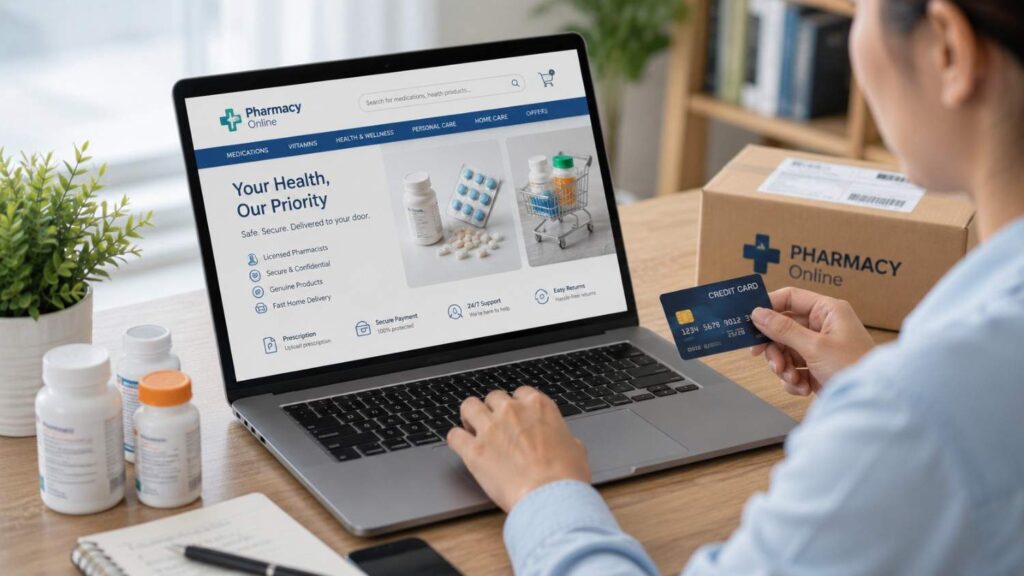
How to Choose a Reliable Online Pharmacy
Learning how to choose a reliable online pharmacy is increasingly important because a polished website does not prove that the seller is licensed, that its medicines are genuine, or that qualified healthcare professionals supervise the dispensing process. Fraudulent sites can copy logos, display invented reviews, use secure-looking web addresses, and imitate recognised pharmacy brands.
Legitimate online pharmacies can offer useful benefits. Patients may receive repeat-prescription support, discreet ordering, home delivery, refill reminders, and easier access when mobility, distance, or working hours make in-person collection difficult. These advantages are valuable only when the pharmacy follows the same professional and legal safeguards expected from a physical dispensing location.
Unsafe websites may sell expired, falsified, unapproved, contaminated, incorrectly labelled, or poorly stored products. According to FDA guidance, medicines from unsafe sites may contain the wrong active ingredient, too much or too little of the expected ingredient, no active ingredient, or harmful substances. Poor temperature control can also make some medicines ineffective.
The World Health Organization distinguishes falsified medical products, which deliberately misrepresent their identity, composition, or source, from substandard products that fail to meet required quality standards. WHO reports that these products affect every region and are frequently distributed through unauthorised websites and informal markets.
In my experience, the safest approach is to verify the seller before comparing prices. Licensing, prescription safeguards, pharmacist access, and supply-chain transparency matter more than convenience, advertising, or discounts. The following sections explain how to investigate each of these areas before sharing medical information or placing an order.
Verify the Pharmacy’s Licence and Legal Status
Licence verification is the most important first step because it provides independent evidence that a pharmacy is legally recognised and subject to professional oversight. A licence does not guarantee that every transaction will be perfect, but the absence of verifiable authorisation is a strong reason not to proceed.
The relevant regulator depends on where the pharmacy is established, where the medicine is dispensed, and where the customer receives it. In some jurisdictions, a pharmacy must be authorised both in its home location and in the patient’s location. Cross-border or interstate dispensing can therefore require more than one approval.
Verification should take place through an official government, pharmacy-board, or recognised regulatory database. Do not begin with a link supplied by an unfamiliar seller. Instead, search independently for the regulator, open its official website, and enter the pharmacy’s name or domain yourself. This reduces the risk of being redirected to a copied or fraudulent verification page.
In the United States, FDA BeSafeRx directs consumers to state boards of pharmacy, while NABP offers tools for checking medicine-selling websites. NABP states that a verified pharmacy should be appropriately licensed, accept valid prescriptions, comply with pharmacy laws, provide accessible contact information, and protect patient confidentiality.
European consumers should use the appropriate national register. The EU’s common online-medicine logo is meaningful only when clicking it leads to the retailer’s entry on an official national-authority website. UK consumers can check the current MHRA register, while Pakistani consumers should consult DRAP and applicable provincial pharmacy authorities.
Search an official regulator’s database
Open the regulator’s website independently and search using the pharmacy’s legal business name, trading name, domain, address, or licence number. The result should show a current or active registration rather than a suspended, expired, cancelled, or pending status. Read any limitations listed in the record because some licences permit only certain activities.
US consumers can use state board databases and FDA BeSafeRx resources. NABP’s Safe Site Search Tool can also indicate whether a domain is verified, not recommended, or not yet reviewed. NABP explains that sites may be classified as not recommended when they appear to sell prescription medicines without valid prescriptions, offer unauthorised products, or practise pharmacy without the required licences.
Within the EU and European Economic Area, the seller should appear in the relevant national register. The common logo should display the flag of the country where the retailer is authorised and redirect users to that official record. A logo showing the general EU flag, or one that leads back to the seller’s own website, should not be accepted as proof.
In Pakistan, DRAP’s product registry can help confirm whether a pharmaceutical product is registered. DRAP states that products not registered with the authority generally cannot be imported or supplied unless a specific exemption applies. Product registration and pharmacy licensing are separate checks, so buyers should confirm both where relevant.
Readers in Pakistan may also find this online pharmacy guide in Pakistan helpful for understanding common safety practices alongside official DRAP verification resources.
Match the licence with the website details
After finding a regulatory record, compare it carefully with the website. The legal name, trading name, physical address, telephone number, email domain, and web address should be consistent. Minor differences in punctuation or abbreviations may be harmless, but a different country, unrelated company name, or mismatched domain requires clarification.
Check whether the regulatory record identifies the same premises as the website. Some unsafe sellers copy the name or licence number of a real pharmacy while operating through an unrelated domain. Verification is therefore incomplete unless the domain and business details correspond.
Contact the pharmacy using the number shown in the official record rather than relying only on the website’s contact button. Ask who owns the service, where prescriptions are dispensed, and whether a third-party pharmacy or fulfilment company is involved. Staff should provide clear, consistent answers.
The FTC advises buyers to confirm a seller’s physical address and telephone number before providing personal or financial information. It also warns that seals, logos, guarantees, and professional-looking designs can be copied or fabricated.
Review any disciplinary history, warning, limitation, or public notice associated with the licence. A previous complaint does not automatically prove that the pharmacy is currently unsafe, but unresolved enforcement action deserves careful consideration.
When the pharmacy’s identity, address, domain, or licence cannot be matched confidently, do not submit a prescription or payment. Choose another authorized provider rather than accepting an explanation that cannot be independently verified.
For additional practical verification tips, this reputable online pharmacy guide provides a useful overview of the checks consumers can make before ordering medicines online.
| Verification Method | What to Check | Why It Matters | Risk if Ignored |
|---|---|---|---|
| Official Licence Database | Confirm registration with the national regulator | Verifies legal operation | Fake or unlicensed pharmacy |
| Pharmacy Business Details | Match the name, address, and phone number | Confirms identity | Fraudulent business information |
| Registered Pharmacist | Ensure pharmacist support is available | Improves medicine safety | No professional guidance |
| Prescription Requirement | Check if prescriptions are required when legally necessary | Prevents unsafe medicine use | Illegal medicine sales |
| Regulatory Approval Logo | Verify that the logo links to the official register | Confirms authenticity | Fake trust badges |
| Website Domain Consistency | Compare the domain with official records | Reduces impersonation risk | Phishing or cloned websites |
Review Prescription and Pharmacist Requirements
A reliable online prescription pharmacy functions as a healthcare service, not merely as a retail website. Its dispensing process should protect patients from receiving the wrong medicine, an unsuitable dose, an unsafe combination, a duplicated therapy, or a product that conflicts with a known allergy or medical condition.
Prescription rules vary by jurisdiction and by medicine. Some products are available without a prescription, while others require authorisation from an appropriately licensed prescriber. Controlled medicines and high-risk treatments may be subject to additional restrictions, identity checks, or dispensing limits.
The pharmacy should explain how it receives and verifies prescriptions. Acceptable processes may include secure electronic prescribing, direct communication with the prescriber, a protected upload system, or presentation of an original prescription where local law requires it. A vague request to send a photograph through an unsecured messaging account deserves caution.
Online consultations can be legitimate when they involve a genuine clinical assessment. A qualified prescriber may review symptoms, diagnoses, allergies, pregnancy status, current medicines, past treatments, and relevant health history. An automated questionnaire that approves nearly everyone without meaningful review does not provide the same safeguard.
FDA and NABP guidance identify the requirement for valid prescriptions and access to a licensed pharmacist as core signs of a safer online pharmacy. Websites offering prescription-only products without appropriate authorisation are a major warning sign.
Before ordering, confirm who will prescribe, who will dispense, who can answer clinical questions, and how prescription problems are resolved.
Confirm that prescription medicines require authorisation
A legitimate pharmacy should request a valid prescription whenever the medicine is legally classified as prescription-only. It may receive the prescription electronically from the prescriber, confirm it directly with the clinic, or use another secure and legally accepted method.
Be cautious when a seller promotes “no prescription needed,” offers prescription medicine after a very short questionnaire, or allows customers to select their own strength without medical review. FDA guidance lists failure to require a prescription as a clear warning sign of an unsafe online pharmacy.
A genuine telehealth assessment should be more than a sales form. The prescriber may need to ask about existing diagnoses, symptoms, allergies, kidney or liver problems, pregnancy, other medicines, and previous adverse reactions. The amount of information required depends on the medicine and the applicable professional rules.
The pharmacy should not encourage customers to change a prescribed dose, combine treatments, or substitute a different medicine solely because it is cheaper or available. Any clinically significant substitution should be authorised according to local law and explained by a pharmacist or prescriber.
Prescription verification also protects against duplication and dangerous interactions. A pharmacist may contact the prescriber when directions are unclear, the dose appears unusual, or the medicine conflicts with another treatment.
When a website appears more interested in completing the sale than confirming whether the medicine is appropriate, do not proceed. Convenience should never remove the clinical safeguards attached to prescription-only treatment.
Check access to a qualified pharmacist
A safe online pharmacy should provide meaningful access to a licensed pharmacist. The pharmacist should be available to answer questions about how to take the medicine, what to do after a missed dose, possible interactions, storage requirements, expected adverse effects, and warning signs that require medical advice.
FDA guidance specifically identifies pharmacist access as one of the signs of a safer online pharmacy. A customer-service agent who can discuss payment or tracking but cannot provide clinical counselling is not an adequate substitute.
Look for clear information about pharmacist availability. The site should explain whether counselling is offered by telephone, secure chat, video consultation, or another protected method. Opening hours, response expectations, and emergency limitations should be stated.
Test the service before placing an important first order. Ask a reasonable question about storage, administration, or potential interaction. The response should be specific, professional, and focused on patient safety rather than sales.
Dispensing labels should include the medicine name, strength, dosage form, directions, pharmacy details, and required warnings. Where applicable, the patient’s name and prescriber’s information should also appear.
The pharmacist should be able to explain an approved generic substitution or unexpected change in packaging. When the medicine looks different, do not rely on an automated reply. Obtain confirmation from the dispensing pharmacist before taking it.
Limited pharmacist access, vague answers, or pressure to contact the manufacturer instead may indicate that the website is acting as a marketplace rather than a properly supervised pharmacy.
Related Articles
Examine Website Transparency, Privacy, and Payment Safety
A licence establishes regulatory status, but the website must also operate transparently. Before uploading a prescription, identification document, insurance information, or payment details, review who owns the service and how it handles sensitive data.
The pharmacy should identify its legal entity, dispensing location, physical address, telephone number, operating hours, and professional contacts. It should also explain whether another pharmacy, telehealth provider, payment processor, insurer, or delivery company participates in the service.
Privacy policies deserve careful attention because prescription information can reveal diagnoses, treatments, addresses, dates of birth, and other sensitive details. The policy should explain what data is collected, why it is required, how it is protected, how long it is retained, and which third parties may receive it.
Payment security is equally important. The checkout page should use encryption, but a padlock symbol alone does not prove that the business is legitimate. Fraudulent websites can obtain HTTPS certificates and imitate trusted brands. Licensing and identity verification remain necessary. The FTC specifically notes that security indicators can be forged and should not replace research into the seller.
Read the delivery, cancellation, refund, damaged-order, and complaint procedures before paying. Medicines may be subject to return restrictions because returned products cannot always be safely resold, but the pharmacy should explain how it handles incorrect, damaged, contaminated, or delayed orders.
A reliable site makes essential information easy to find. Hidden ownership, vague policies, anonymous communication, and unusual payment instructions indicate avoidable risk.
Look for clear ownership and contact information
The website should display the legal name of the pharmacy, its physical premises, telephone number, email address, operating hours, and professional registration details. This information should match the official licensing record and appear consistently across the website, invoice, prescription process, and parcel label.
Avoid sellers that communicate only through social-media direct messages, anonymous web forms, temporary telephone numbers, or encrypted chat accounts. WHO identifies concealed physical addresses and missing landline details as warning signs commonly associated with unauthorised sellers of substandard or falsified medical products.
The site should explain whether it dispenses medicines directly or sends orders to a separate partner pharmacy. When a third party is involved, its identity and regulatory status should be disclosed. Customers need to know which licensed professional is responsible for the supplied medicine.
Review the complaints process. It should explain how to report a wrong item, broken seal, missing parcel, billing error, or suspected adverse reaction. A clear escalation route should be available when ordinary customer support cannot resolve the problem.
Check the cancellation and refund terms before ordering. Prescription medicines may not be returnable after dispatch, but this does not excuse the pharmacy from addressing incorrect or damaged supplies.
A trustworthy business should be willing to answer basic questions about ownership and dispensing arrangements. Evasive responses, copied contact details, or an address that belongs to an unrelated organisation are strong reasons to stop the transaction.
Protect medical and financial information
Read the pharmacy privacy policy before creating an account. It should describe the personal, medical, insurance, prescription, and payment information collected through the website or application. It should also explain the lawful purpose for collection and whether data is shared with healthcare partners, insurers, couriers, analytics providers, or marketing companies.
The site should use encryption when transmitting prescriptions, identification, and payment details. Look for an HTTPS address, but remember that encryption protects data in transit; it does not establish that the operator is licensed or honest. The FTC warns that security icons and professional website features are not foolproof.
Avoid sending prescriptions, identity documents, or card information through ordinary email or informal messaging unless the pharmacy provides a secure, approved process. Ask how uploaded documents are stored and when they are deleted.
Choose a payment method that provides a receipt, transaction history, and dispute mechanism. Credit or debit card payments are generally easier to trace than cryptocurrency, gift cards, wire transfers, peer-to-peer transfers, or payment to an unrelated personal account.
NABP lists cryptocurrency-only or peer-to-peer payment requirements, unclear privacy protections, and the sale of customer information among common warning signs of unsafe pharmacy websites.
Keep copies of the order confirmation, prescription submission, invoice, communication, tracking details, and pharmacy licence result. These records may be necessary for a billing dispute, regulatory complaint, or investigation of an incorrect medicine.
Assess Medicine Quality, Packaging, and Delivery
The pharmacy’s duty does not end when payment is accepted. Medicines should come from an authorised supply chain, be dispensed against the correct prescription, labelled accurately, and transported under appropriate conditions.
Storage requirements differ between products. Some medicines remain stable at ordinary room temperature, while others require refrigeration, protection from light, controlled humidity, or a narrow temperature range. A delivery process that is suitable for one medicine may be unsafe for another.
FDA guidance warns that medicines stored without required temperature controls may lose effectiveness. Unsafe online sellers may also supply products containing incorrect ingredients or strengths.
Before ordering, read the pharmacy’s delivery policy. It should explain dispatch times, tracking, weekend and holiday handling, temperature-sensitive shipping, failed-delivery procedures, and what happens when a parcel is delayed. A reliable pharmacy should not make unrealistic promises for products that require special handling.
When the parcel arrives, inspect it before taking the medicine. Confirm that the patient, product, strength, quantity, directions, and prescriber details are correct. Check the manufacturer, batch number, expiry date, security seals, leaflet, and condition of the packaging.
WHO advises consumers to examine packaging for damage, spelling errors, inconsistent dates, discolouration, degradation, unusual smells, and signs of tampering. It also recommends confirming that details on inner and outer packaging match.
When anything appears inconsistent, isolate the product and contact the pharmacist. Do not guess that a difference is harmless.
Inspect the product when it arrives
Begin by comparing the supplied medicine with the order confirmation and prescription. Check the medicine name, active ingredient, strength, dosage form, quantity, and directions. A small difference in strength or formulation can be clinically important, even when the brand name looks familiar.
Inspect the dispensing label. It should be readable and securely attached, with the patient’s information where applicable, clear instructions, the pharmacy’s details, and necessary warnings. A label belonging to another patient is a serious dispensing error and should be reported immediately.
Examine the manufacturer’s packaging, seals, batch number, manufacturing date, and expiry date. WHO advises checking that expiry and batch information on the internal packaging matches the external box. Look for spelling mistakes, poor printing, altered labels, damaged blister packs, loose tablets, discolouration, unusual odours, leakage, or missing patient information.
A tablet may legitimately look different when the manufacturer or approved generic supplier changes. Colour, shape, imprint, or packaging differences do not automatically prove falsification. However, the dispensing pharmacist should confirm the reason before you take the medicine.
Photograph damaged or suspicious packaging and keep the parcel, receipt, and labels. Do not discard evidence until the pharmacy or regulator advises you.
When the seal is broken, the expiry date is missing, the medicine appears contaminated, or the pharmacy cannot confirm its origin, do not use it. Contact a healthcare professional and report the concern through the appropriate regulatory channel.
Review shipping and storage arrangements
Before ordering, determine whether the medicine requires refrigeration, insulation, protection from freezing, shielding from sunlight, humidity control, or delivery within a specific period. The pharmacy should understand these requirements and explain how they are maintained during transport.
Temperature-controlled products may need insulated packaging, cooling materials, temperature indicators, or expedited delivery. Ask how the pharmacy handles weekends, public holidays, customs delays, missed deliveries, and parcels left unattended.
Tracking information should allow the customer to anticipate arrival. Tamper-evident packaging and proof of delivery may be appropriate for sensitive, high-value, or regulated medicines.
Inspect the parcel immediately. If a refrigerated product arrives warm, frozen, leaking, delayed, or without the expected temperature-control materials, place it in the storage condition recommended on the label but do not use it until the pharmacist or manufacturer confirms whether it remains suitable.
FDA guidance notes that improper storage may make medicine ineffective. The safe response depends on the product, the temperature reached, and the duration of exposure, so general assumptions are unreliable.
The pharmacy should have a written process for damaged parcels and temperature excursions. It should not dismiss the concern or tell customers to use the medicine without checking product-specific stability information.
For urgently needed treatment, standard parcel delivery may be inappropriate. Discuss alternatives with the prescriber or a local pharmacy before the existing supply runs out.
| Reliability Factor | Good Practice | Poor Practice |
|---|---|---|
| Medicine Packaging | Sealed, labelled, expiry date visible | Damaged or missing labels |
| Shipping Conditions | Temperature-controlled when required | No storage information provided |
| Delivery Tracking | Tracking number and delivery updates | No shipment visibility |
| Customer Support | Responsive support with pharmacist access | Only automated responses |
| Privacy Protection | Clear privacy and data protection policy | Unclear handling of personal data |
| Payment Security | Secure payment gateway with receipts | Requests for gift cards or anonymous payments |
| Product Information | Complete dosage and usage instructions | Missing or incomplete medicine details |
| Return & Complaint Policy | Clearly explained process | No refund or complaint information |
Recognise Online Pharmacy Red Flags Before Paying
Unsafe pharmacy websites commonly use urgency, secrecy, unusually low prices, or exaggerated health claims to encourage payment before the customer verifies the business. Recognising these tactics can prevent both medical and financial harm.
A single unusual feature may have an innocent explanation, but several warning signs together should end the transaction. The strongest red flags include prescription-only medicines sold without authorisation, unverifiable licensing, no pharmacist access, hidden ownership, anonymous payment, or products sourced from an unclear country or supply chain.
FDA guidance warns consumers about sites that do not require prescriptions, offer prices that appear too good to be true, lack a licensed pharmacist, provide unclear privacy protections, or send medicines in damaged, foreign-language, expired, or inconsistent packaging.
WHO additionally warns against spam advertising, suspiciously low prices, unverified certification logos, missing physical addresses, and websites offering prescription-only products without prescriptions.
Marketing claims require special caution. No responsible pharmacy should guarantee a cure, claim that a medicine has no risks, describe a product as suitable for everyone, or encourage customers to stop existing treatment without consulting a qualified clinician.
Reviews, testimonials, influencer endorsements, and “verified buyer” labels may be useful for learning about delivery service, but they do not prove licensing or medicine authenticity. Regulatory verification must come first.
When the seller pressures you to order immediately, discourages questions, refuses to identify the dispensing pharmacy, or demands an untraceable payment, leave the website and use another licensed provider.
Avoid no-prescription offers and unrealistic claims
A website that offers prescription-only medicine without a valid prescription removes an essential safety safeguard. The prescription process helps ensure that the medicine, dose, duration, and monitoring plan are appropriate for the patient.
FDA and NABP both identify the absence of a valid prescription requirement as a major sign of an unsafe online pharmacy. NABP reports that this behaviour is common among illegal pharmacy websites.
Be cautious of sellers claiming that a short questionnaire can replace medical review in every situation. Legitimate telehealth prescribing may use questionnaires, but a qualified clinician should assess relevant history and be able to decline treatment when it is unsafe.
Avoid claims such as “guaranteed cure,” “no side effects,” “works for everyone,” or “better than all approved treatments.” The FTC warns that health scams frequently use miracle claims, scientific-sounding language, testimonials, or supposedly natural alternatives to create false confidence.
Very low prices are not proof of fraud because approved generics and legitimate discounts can reduce costs. Concern increases when extreme discounts appear alongside hidden contact details, no prescription, bonus pills, or unclear product origins.
Do not buy from unsolicited emails, social-media comments, private messaging accounts, pop-ups, or influencers unless you can independently verify the dispensing pharmacy.
A legitimate seller will prioritise safe dispensing over rapid conversion. It should be willing to explain limitations, reject an inappropriate order, and advise the customer to contact a prescriber when necessary.
Do not trust badges, reviews, or foreign claims without verification
A logo or certificate displayed on a pharmacy website is useful only when it can be verified independently. Select the badge and confirm that it leads to the pharmacy’s current record on an official regulatory website.
The EU common logo must redirect the user to the seller’s entry in the relevant national register. European authorities advise customers not to continue when the logo does not open the official register or the retailer is absent from the list.
Reviews should be read critically. Positive comments may be fabricated, purchased, duplicated, or posted by people who can evaluate delivery speed but not medicine authenticity. Negative reports about incorrect products, unauthorised charges, hidden subscriptions, missing pharmacist access, or non-delivery deserve investigation.
Foreign claims can also be misleading. A website may imply that its medicine comes from a highly regulated country even though the actual manufacturing, storage, or dispensing location is unclear. FDA warns that fake storefronts may imitate foreign pharmacies with strong reputations while selling products made elsewhere.
Cross-border orders may involve different prescription rules, approved formulations, product names, customs restrictions, and patient protections. Within the EU, rules for online prescription sales still vary between countries.
Do not assume that an international domain ending, foreign flag, or imported-looking package proves origin. Verify the pharmacy in its home jurisdiction and confirm that it is authorised to supply patients where you live.
How to Choose a Reliable Online Pharmacy Step by Step
Use a consistent verification process rather than selecting the first sponsored result or the lowest advertised price. A structured checklist makes it easier to compare sellers and prevents persuasive design from replacing objective safety checks.
Begin with the regulator. Search for the pharmacy independently and confirm its current licence, legal name, physical address, and authorised activities. Next, determine whether prescription-only medicines require a valid prescription and whether a licensed pharmacist is available for counselling.
Review the website’s ownership, privacy, payment, delivery, cancellation, refund, and complaints information. Confirm who dispenses the medicine and whether third-party prescribers, pharmacies, or delivery providers participate.
Assess the total cost rather than the product price alone. Dispensing charges, delivery fees, subscription terms, insurance conditions, and automatic refills can change the final amount. In Pakistan, all amounts should be displayed clearly in PKR or the currency that will actually be charged, without hidden conversion or processing fees.
Before placing an urgent order, confirm stock availability, dispatch timing, weekend handling, and what happens when the prescription requires clarification. Do not rely on ordinary parcel delivery when missing a dose could create a medical risk.
After delivery, compare the product with the prescription, inspect the label and packaging, and confirm storage conditions. Keep records of the verification, order, payment, correspondence, and shipment.
The table below summarises the difference between a safer pharmacy and a high-risk seller. These checks align with recommendations from FDA, NABP, WHO, FTC, and European regulators.
| Check | Reliable sign | Warning sign |
|---|---|---|
| Licence | Listed in an official regulator database | Licence cannot be independently verified |
| Prescription | Requires valid authorisation when legally necessary | “No prescription needed” |
| Pharmacist | Qualified pharmacist available for counselling | Only sales or tracking support |
| Address | Real physical address and telephone number match registration | Hidden, false, or inconsistent location |
| Pricing | Product, dispensing, delivery, and service costs are clear | Unrealistic discount or surprise fee |
| Privacy | Detailed policy explains collection and sharing | Vague policy or sale of customer data |
| Payment | Traceable payment and formal receipt | Gift card, cryptocurrency, wire, or personal account |
| Medicine | Correct label, batch, seals, and expiry information | Broken, unlabelled, contaminated, or expired package |
| Delivery | Storage and delay procedures are explained | No temperature or shipping guidance |
| Complaints | Clear support and escalation process | No meaningful response after payment |
Compare total service quality, not only price
Price matters, especially for long-term treatment, but the cheapest offer may not represent the lowest overall risk or cost. Compare the medicine price, dispensing fee, delivery charge, insurance handling, consultation cost, subscription terms, and refill policy.
Check whether the displayed price is for the correct strength, dosage form, pack size, and manufacturer. A lower price may apply to a smaller quantity or different formulation. In Pakistan, confirm that the checkout total is shown clearly in PKR when that is the billing currency.
Review stock availability before uploading the prescription. Some websites accept payment while a product is unavailable, creating delays that may interrupt treatment.
Ask about dispatch cut-off times, weekend delivery, remote-area service, and the procedure for prescription questions. A pharmacy that cannot confirm when an urgent medicine will leave the premises may not be suitable for time-sensitive treatment.
I recommend asking the pharmacist one genuine clinical or storage question before the first order. The quality of the response can show whether the service provides meaningful professional support or operates primarily as a product marketplace.
Consider accessibility as well. A reliable service should offer understandable instructions, readable labels, and support for patients who need language assistance or help managing repeat medicines.
Value should be measured through licensing, accuracy, pharmacist access, transparent charges, dependable delivery, privacy, and complaint handling—not price alone.
Keep records and report problems
Save evidence from each stage of the purchase. Keep a copy or screenshot of the regulatory listing, pharmacy licence details, product page, prescription submission, order confirmation, invoice, payment record, communication, and tracking information.
These records can help resolve an incorrect order, hidden subscription, non-delivery, duplicated charge, privacy complaint, or regulatory investigation. They may also show what the website claimed about medicine origin, storage, or approval at the time of purchase.
If the medicine appears falsified, damaged, ineffective, or incorrectly dispensed, do not rely solely on the seller’s reassurance. Contact the dispensing pharmacist, prescriber, or another qualified healthcare professional. Do not abruptly stop an essential medicine without clinical advice unless an emergency professional directs you to do so.
WHO recommends reporting suspected substandard or falsified products to a healthcare professional and the national medicines regulatory authority. It also advises prompt reporting when the medicine appears ineffective or causes an adverse reaction.
US consumers can report suspected unlawful online sales through FDA resources and adverse events through MedWatch. FDA also publishes warning letters concerning sites accused of offering unapproved products or prescription medicines without appropriate safeguards.
Consumers in other countries should use their national medicines regulator, pharmacy authority, consumer-protection body, or healthcare professional. Report payment fraud promptly to the card provider or relevant financial institution.
Quick Answer About How to Choose a Reliable Online Pharmacy
Start by checking the pharmacy through an official medicines or pharmacy regulator. Do not rely solely on a badge, licence number, review score, sponsored search result, or professional-looking website. The pharmacy’s legal name, physical address, telephone number, domain, and current licence status should match the regulator’s records. In the United States, consumers can use state pharmacy boards, FDA BeSafeRx resources, and NABP’s verification tools. European consumers should confirm that the common EU logo leads directly to the seller’s entry in the appropriate national register. Pakistan-based consumers can consult DRAP resources for registered medicines and use pharmacies authorised under applicable local rules.
A legitimate seller should require a valid prescription whenever a medicine is classified as prescription-only. It should also provide access to a licensed pharmacist who can answer questions about dosage, interactions, storage, adverse effects, missed doses, and unexpected changes in the medicine’s appearance. A customer-service representative who only handles deliveries is not a substitute for professional pharmacy support.
Before paying, review the website’s ownership, privacy policy, payment options, delivery process, refund conditions, and medicine-storage arrangements. Avoid no-prescription offers, miracle claims, unusually deep discounts, hidden contact details, anonymous payment methods, and medicines arriving in damaged, unlabelled, expired, or inconsistent packaging. WHO recommends checking packaging quality, manufacturing and expiry details, seals, smell, colour, and batch information after delivery.
Frequently Asked Questions About How to Choose a Reliable Online Pharmacy
Choosing an online pharmacy involves more than deciding whether the website looks professional or offers an attractive price. The seller handles prescription information, medical details, payment data, and products that may directly affect the customer’s health.
The most important questions concern authorisation, professional supervision, prescription verification, product origin, and accountability. A legitimate seller should be identifiable through an official regulator, provide access to a pharmacist, require lawful prescriptions, and explain who is responsible for dispensing the medicine.
Consumers should also understand the limits of common website signals. HTTPS protects information sent between a device and a website, but it does not prove that the business is licensed. Reviews may provide information about customer service, yet they cannot establish medicine authenticity. Badges and logos are useful only when they lead to an independent regulatory record.
Price differences also need context. Approved generic medicines may legitimately cost less than branded alternatives. However, an unusually low price becomes concerning when it appears alongside no-prescription sales, unclear ownership, anonymous payment, or an unverifiable supply chain.
Cross-border purchasing creates additional questions about prescribing law, customs, product approvals, storage, and complaint rights. A medicine legally sold in one country may not be authorised or suitable for online sale in another.
The answers below address the most common search questions. They are general consumer-safety guidance and do not replace advice from a pharmacist, doctor, national regulator, or other qualified professional.
How do I verify whether an online pharmacy is legitimate?
Begin with the official pharmacy or medicines regulator in the jurisdiction where the seller operates. Search independently for the business name, address, licence number, and website domain. The record should show a current authorisation and should match the details displayed on the pharmacy website.
US consumers can use state boards of pharmacy, FDA BeSafeRx resources, and NABP’s Safe Site Search Tool. NABP may identify a site as verified, not recommended, or not reviewed.
EU consumers should select the common logo and confirm that it opens the pharmacy’s entry in the national register. Do not proceed when the logo returns to the seller’s website or the pharmacy is missing from the official list.
Pakistan-based customers can use DRAP resources to check registered medicines, while pharmacy licensing should be confirmed through the appropriate local authority.
Finally, compare the official record with the site’s physical address, telephone number, ownership, and domain. Do not accept a licence number that belongs to another business or website.
Should a legitimate online pharmacy require a prescription?
Yes, when the medicine is legally classified as prescription-only. A valid prescription helps confirm that a qualified healthcare professional has assessed the treatment, strength, dosage, duration, and relevant patient factors.
FDA and NABP both identify prescription-only medicines sold without a valid prescription as a major warning sign.
The exact process varies. A pharmacy may receive an electronic prescription directly from the prescriber, verify a secure upload, contact the clinic, or use another method permitted by local law. Some online services combine telehealth prescribing with pharmacy dispensing, but the clinical assessment should be genuine rather than automatic.
A short questionnaire is not necessarily unsafe, but it should collect relevant medical information and be reviewed by an appropriately licensed prescriber. The clinician should be able to refuse treatment or request further assessment.
Do not purchase from a website that lets you choose any prescription medicine or dose without professional review. Also avoid sellers that encourage you to replace or stop existing treatment without consulting your prescriber.
Rules differ by country and medicine, so confirm the classification with a local pharmacist or regulator when uncertain.
Does HTTPS mean an online pharmacy is safe?
No. HTTPS means that information exchanged between your device and the website is encrypted. This is important when transmitting passwords, prescriptions, health information, or payment details, but it does not prove that the website operator is licensed or trustworthy.
Fraudulent businesses can obtain security certificates and display a padlock in the browser. They can also copy pharmacy logos, use convincing product photographs, publish fabricated testimonials, and create official-looking seals.
The FTC advises consumers to look for HTTPS but warns that security indicators can be forged and are not foolproof. It recommends confirming the seller’s identity, physical address, telephone number, and licensing independently.
Treat HTTPS as one part of a broader safety assessment. Verify the pharmacy through an official regulatory database, confirm that prescription-only medicines require authorisation, and check that a licensed pharmacist is available.
Read the privacy policy to understand how the site stores and shares medical data. Use a traceable payment method and avoid sending prescriptions or card details through ordinary email or informal messaging.
A secure connection protects data transmission. Regulatory verification, professional oversight, and transparent business practices establish whether the pharmacy itself is reliable.
Are very cheap online medicines always fake?
No. Approved generic medicines, insurance arrangements, bulk purchasing, manufacturer discounts, and lower service costs can produce legitimate savings. A lower price does not automatically indicate that the medicine is falsified.
The concern arises when the price is dramatically below normal market levels and appears alongside other warning signs. These may include no prescription requirement, unverifiable licensing, hidden ownership, bonus pills, anonymous payment, unclear medicine origin, or pressure to order immediately.
FDA and WHO both identify suspiciously low prices and offers that appear too good to be true as warning signs associated with unsafe medicine sellers.
Compare like with like. Confirm the active ingredient, strength, dosage form, quantity, manufacturer, delivery fee, consultation charge, and subscription terms. A low headline price may apply to a smaller pack or exclude important fees.
In Pakistan, confirm the final amount in PKR and review whether any international payment, conversion, customs, or delivery charges apply.
Verify the pharmacy before considering the discount. A genuine low price from a licensed provider can be valuable. A low price from an unverified seller may expose the buyer to ineffective medicine, financial fraud, or serious health harm.
What should I do if the delivered medicine looks different?
Do not take the medicine until the dispensing pharmacist confirms why it looks different. Approved generic products may vary in colour, shape, imprint, packaging, or manufacturer while containing the same active ingredient and strength. However, unexpected differences should always be verified.
Compare the medicine name, active ingredient, strength, dosage form, quantity, directions, manufacturer, batch number, expiry date, seals, and dispensing label with the prescription and order.
WHO recommends checking packaging for spelling mistakes, poor condition, mismatched manufacturing or expiry information, discolouration, degradation, unusual smells, and signs of tampering.
Photograph the packaging and medicine. Keep the box, blister pack, bottle, leaflet, parcel label, and receipt. Contact the pharmacy using its verified telephone number and ask to speak with the pharmacist.
Do not accept a vague explanation from a delivery agent or general customer-service representative. Clinical confirmation should come from the dispensing pharmacy.
When the label belongs to another patient, the seal is broken, the expiry date is missing, or contamination is suspected, isolate the product and report the problem. Seek medical advice promptly if you have already taken it and experience an adverse effect.
Is it safe to order medicine from another country?
Cross-border ordering can introduce legal, clinical, customs, and supply-chain complications. The medicine may have a different name, strength, formulation, approved indication, or package from the version available in your country.
The seller may be legally authorised in its home jurisdiction but not permitted to supply customers where you live. Prescription requirements and online-sales rules also differ. Within the EU, national registers indicate authorised retailers, but countries still set their own rules for online prescription-medicine sales.
Shipping can create additional risk for temperature-sensitive products, especially when customs or international delivery delays occur. Complaint, refund, and compensation rights may also be harder to enforce across borders.
Verify the seller in its home country and confirm that it is authorised to deliver to your location. Check whether the medicine itself is approved or registered by your national regulator.
Pakistan-based consumers should consult DRAP information and applicable import rules before ordering from abroad. US consumers should review FDA BeSafeRx guidance regarding medicines outside the authorised US supply chain.
When a local licensed pharmacy can supply the prescribed medicine, that route generally provides clearer regulatory protection and easier access to professional support.
Conclusion
Knowing how to choose a reliable online pharmacy protects far more than the money spent on an order. It reduces the risk of receiving falsified, expired, incorrectly labelled, poorly stored, or clinically inappropriate medicine. It also helps protect prescription information, identity details, and payment data from misuse.
The safest process begins with independent verification. Search for the pharmacy through the relevant medicines regulator or pharmacy board and confirm that the registered name, address, telephone number, domain, and authorised activities match the website.
Next, assess the professional safeguards. Prescription-only medicines should require valid authorisation, and a licensed pharmacist should be available for clinical questions. The website should clearly identify who dispenses the medicine and how prescription problems are resolved.
Privacy, payment, delivery, and complaint policies also matter. Avoid websites that conceal ownership, demand anonymous payment, or fail to explain how personal data is shared. Confirm how temperature-sensitive medicines are shipped and what happens when a parcel is delayed or damaged.
After delivery, inspect the medicine before use. Check the patient label, name, strength, dosage form, quantity, manufacturer, batch number, expiry date, seals, leaflet, and packaging condition. Confirm any unexpected difference with the pharmacist.
Convenience and savings can be genuine benefits of online pharmacy services, but they should never replace regulatory and clinical safeguards. When information cannot be independently verified, use another licensed provider.
Key points to remember
Verify the pharmacy through an official regulator before comparing prices, delivery times, reviews, or promotional offers. A badge displayed on the seller’s website is not enough unless it leads to a current official registration.
Confirm that prescription-only medicines require valid authorisation. The pharmacy should not let customers select high-risk treatments or doses without appropriate professional review.
Check that a licensed pharmacist is accessible. The pharmacist should be able to answer questions about dosage, interactions, storage, adverse effects, missed doses, and unexpected changes in appearance.
Review the website’s ownership, physical address, telephone number, privacy policy, payment methods, delivery arrangements, and complaints process. Avoid hidden locations, untraceable payment, miracle claims, bonus-pill offers, and unusually aggressive sales tactics.
Inspect every parcel. Confirm that the label and product match the prescription, and check the batch number, expiry date, seals, leaflet, and packaging. WHO advises consumers to report suspected falsified products or treatment failure to a healthcare professional and national regulator.
Keep copies of the licence search, receipt, prescription, messages, and tracking information. These records provide evidence when reporting unsafe sales, billing errors, incorrect medicines, or suspected fraud.
Final recommendation
The safest method is simple: verify first, order second. Do not allow an attractive price, urgent countdown, polished design, or positive review to replace independent regulatory checks.
Use a pharmacy authorised to operate in the relevant jurisdiction and confirm that its website details match its official record. Make sure prescription-only medicines require appropriate authorisation and that a licensed pharmacist can provide counselling.
Ask questions before paying. A reliable provider should explain who dispenses the medicine, how personal data is protected, which payment methods are accepted, how sensitive products are transported, and what happens after a delivery problem.
When the medicine arrives, inspect it before use and contact the pharmacist about any unexpected difference. Do not take a product with broken seals, missing expiry information, another patient’s label, visible contamination, or an unclear origin.
Seek medical advice when a medicine causes an unexpected reaction, appears ineffective, or conflicts with another treatment. Do not stop essential prescribed treatment abruptly without professional guidance unless emergency services instruct you to do so.
Ultimately, a trustworthy pharmacy should make verification easy, answer clinical questions clearly, and place patient safety before sales. When those standards are missing, choose another licensed provider.