
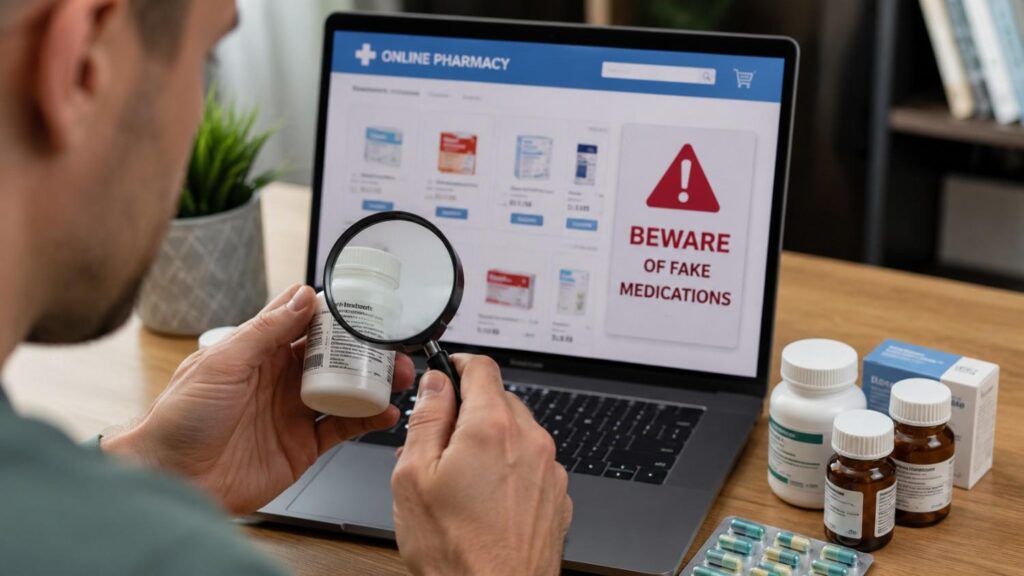
How to Spot Fake Medications Online and Buy Safely
Buying medication online can save time, improve access, and make it easier to manage repeat prescriptions. However, the internet also allows illegal sellers to create convincing pharmacy websites, advertise through social media, and distribute falsified, unapproved, or poorly stored products directly to consumers.
Learning how to spot fake medications online is therefore an important patient-safety skill. A counterfeit medicine may resemble the genuine product closely enough to mislead an ordinary buyer. It may use familiar branding, realistic packaging, copied safety seals, and professional product photographs. The problem is that its contents may be very different from what the label claims.
The U.S. Food and Drug Administration warns that counterfeit medicine may contain the wrong ingredients, an incorrect amount of the active ingredient, no active ingredient, or other harmful substances. The World Health Organization similarly advises consumers to purchase medical products only from trusted and licensed sources and to investigate packaging, expiry dates, physical appearance, and unexpected reactions.
For this reason, identifying fake medication requires more than looking at the tablet or box. You need to examine the entire purchasing process, including the seller’s licence, prescription requirements, pharmacist access, contact information, pricing, payment methods, shipping conditions, and product documentation.
This guide explains how to evaluate an online pharmacy before ordering, inspect medication after delivery, recognize common warning signs, respond to suspicious products, and report unsafe sellers. It is intended as general safety information and should not replace advice from a licensed pharmacist, doctor, poison-control service, or national medicine regulator.
What Are Fake, Falsified, and Substandard Medications?
The terms “fake,” “counterfeit,” “falsified,” and “substandard” are often used interchangeably in everyday conversation, but they can describe different types of product-quality problems. Understanding these distinctions makes it easier to recognize the risks and provide accurate information when reporting a suspicious medicine.
A falsified medicine is intentionally misrepresented. Its identity, composition, strength, manufacturer, source, or distribution history may have been deliberately altered to deceive the buyer. A substandard medicine, by contrast, is generally an authorized product that does not meet the required quality standards or approved specifications. This may result from poor manufacturing, contamination, improper storage, transportation failures, or another quality-control problem.
Both categories can cause harm. A falsified antibiotic may contain too little active ingredient, while a genuine temperature-sensitive product may become ineffective after being stored incorrectly. The patient experiences the same practical problem: the medicine may not perform as expected and could create additional health risks.
It is also important to separate these issues from ordinary differences between authorized products. Generic medicines may have different colours, shapes, manufacturers, or inactive ingredients while still meeting regulatory requirements. A changed appearance should therefore trigger verification rather than an immediate conclusion that the medicine is fake.
The following explanations clarify how these categories differ and why the distinction matters when buying medicines online.
What Is a Falsified or Counterfeit Medicine?
A falsified medicine is a medical product that deliberately misrepresents what it is or where it came from. The packaging may claim that the product was made by a recognized pharmaceutical company even though that company had no involvement in its production. The medicine may also display a fabricated batch number, copied barcode, false licence information, or incorrect manufacturing location.
Its contents may be equally deceptive. According to the FDA, counterfeit medicines may contain too much, too little, or none of the stated active ingredient. They may contain a different ingredient entirely or include substances that could be harmful. This means that a buyer cannot safely judge the product by its name, packaging, advertised strength, or physical appearance alone.
The word “counterfeit” is familiar to consumers, although regulators may prefer “falsified” when describing intentional deception involving medical products. Counterfeiting can involve intellectual-property violations, but the patient-safety concern extends beyond copied branding. The more serious issue is that the product’s quality, composition, and origin cannot be trusted.
Both branded and generic medicines can be falsified. Expensive products are not the only targets; WHO notes that falsification can affect products ranging from high-cost treatments to inexpensive pain medicines.
What Is a Substandard Medicine?
A substandard medicine is an authorized medical product that fails to meet its approved quality standards or specifications. Unlike a falsified product, it may not have been created with the intention of deceiving patients. The failure can result from mistakes or weaknesses in manufacturing, testing, packaging, transportation, or storage.
For example, a manufacturer may produce tablets that contain an inconsistent amount of the active ingredient. A liquid medicine may become contaminated during production, or a refrigerated product may be exposed to excessive heat while being transported. Although the packaging and manufacturer may be genuine, the medicine may no longer provide the expected quality, safety, or effectiveness.
WHO distinguishes substandard medical products from deliberately falsified ones and explains that substandard products fail to meet required quality standards or specifications. This distinction helps regulators determine whether an incident involves criminal deception, manufacturing failure, supply-chain damage, or another quality problem.
Consumers usually cannot confirm these problems without professional testing. A product may appear normal even when its potency has declined or its contents are incorrect. That is why proper sourcing and storage are essential. Purchasing from a licensed pharmacy gives consumers access to a regulated distribution system, documented handling procedures, and a professional who can investigate quality concerns.
Why Fake Medication Can Be Dangerous
Fake or poor-quality medication can create several forms of harm. The most obvious risk is direct toxicity. A falsified product may contain an unexpected chemical, excessive active ingredient, contamination, or another substance capable of causing poisoning, allergic reactions, organ damage, or dangerous interactions with existing treatments.
Treatment failure is another major concern. A medicine containing no active ingredient, an insufficient dose, or a degraded ingredient may allow an illness to worsen. This can be especially serious when the product is intended to treat infections, heart conditions, seizures, diabetes, severe allergies, cancer, or another time-sensitive health problem.
Unexpected dosing also makes clinical decisions more difficult. A doctor may increase or change treatment because the patient appears not to respond, without realizing that the original product was falsified or substandard. The patient may then experience complications when a genuine medicine is later introduced.
Poor-quality antimicrobial products can also contribute to wider public-health problems when pathogens are exposed to inadequate treatment. However, consumers should not attempt to diagnose product quality from symptoms alone. A medicine may appear ineffective for many legitimate reasons, including the nature of the illness, incorrect use, interactions, or individual response.
Any unexpected effect, treatment failure, unusual appearance, or suspected contamination should be discussed promptly with a pharmacist or doctor.
How to Verify an Online Pharmacy Before Ordering
The strongest protection against counterfeit drugs online is to evaluate the pharmacy before entering personal, prescription, or payment information. Once a medicine has arrived, visual inspection may reveal obvious problems, but sophisticated falsified products can be difficult or impossible for consumers to identify. Seller verification therefore provides a more reliable first line of defence.
Start by identifying which authority regulates pharmacies in your country or region. Depending on the location, this may be a national medicines agency, ministry of health, state pharmacy board, professional pharmacy regulator, or another government-approved body. Search the regulator’s website independently rather than trusting a link supplied by the seller.
Next, compare the information shown in the official register with the website you intend to use. The legal business name, trading name, domain, telephone number, licence holder, and physical address should be consistent. A copied registration number that belongs to another pharmacy does not make a website legitimate.
You should also evaluate how the pharmacy handles prescription medicines. Legitimate online pharmacies operate within professional and legal safeguards. They do not treat a prescription as an unnecessary obstacle or promise that every customer will qualify for every medicine.
Finally, review the website’s prices, communication methods, privacy practices, and payment options. No single warning sign proves fraud in every case, but multiple concerns should be treated as a strong reason not to proceed.
Confirm Its Licence Through an Official Register
A pharmacy licence should be verified through an independent official source. Do not rely on a logo, badge, certificate image, or licence number displayed on the seller’s website because these elements can be copied from legitimate businesses.
Find the appropriate regulator through a government website, national pharmacy organization, or recognized medicines authority. Enter the pharmacy’s business name or licence number into the regulator’s register and confirm that the listing is current. Check whether the registered website domain matches the exact website you are visiting. A fraudulent seller may use a name similar to a licensed pharmacy while operating through a different domain.
In the United States, consumers can consult relevant state pharmacy boards and use NABP’s Safe Site Search resources. NABP also maintains information about accredited digital pharmacies. In the European Union, registered online medicine retailers use a common logo that should link directly to the applicable national authority’s official listing. Consumers should click the logo and confirm that the retailer appears in that register.
Examine small differences carefully. Added hyphens, alternative spellings, unusual domain endings, and extra words such as “official,” “global,” or “discount” may indicate an imitation website. When the register and website details do not match exactly, contact the regulator or licensed pharmacy using independently verified contact information.
Check the Prescription and Consultation Process
The way a website handles prescriptions can reveal whether it operates like a genuine healthcare provider or an unregulated seller. A legitimate pharmacy should follow the prescription and dispensing requirements that apply in its jurisdiction. Prescription-only medicine should not be treated like an ordinary consumer product that anyone can purchase without appropriate clinical oversight.
Be cautious when a website offers prescription medicine without requesting a valid prescription or promises automatic approval after a superficial questionnaire. A proper prescribing process may require information about your symptoms, diagnosis, allergies, pregnancy status, existing conditions, current medicines, previous reactions, and other factors that could affect safety.
FDA guidance identifies websites that sell prescription drugs without requiring a prescription as a major concern. The agency also recommends checking whether the pharmacy provides a physical address, appropriate licensing, and access to a licensed pharmacist who can answer questions.
An online questionnaire is not automatically illegitimate, because telehealth services may use structured digital assessments. The important issue is whether a qualified professional reviews the information and can refuse, modify, or delay treatment when it is not appropriate.
Avoid websites that guarantee approval, recommend the same medicine to every customer, or provide no meaningful opportunity to speak with a pharmacist or prescriber.
Examine Prices, Payments, and Contact Details
Price can be an important warning sign, although a low price alone does not prove that medicine is fake. Licensed pharmacies may offer discounts, insurance savings, manufacturer programs, or lower-cost generic alternatives. Concern increases when a product is dramatically cheaper than established sources and the seller provides no reasonable explanation.
Evaluate the payment process carefully. Credit-card payments may provide fraud protections that are unavailable with cryptocurrency, gift cards, cash transfers, or direct wire payments. A seller that insists on difficult-to-reverse payment methods may be attempting to avoid accountability.
Check whether the website provides a physical pharmacy address, working telephone number, privacy policy, delivery terms, and clear customer-support information. Search the address independently and compare it with the regulatory record. A mailbox, residential property, unrelated business, or nonexistent location deserves further investigation.
Do not treat HTTPS or a padlock symbol as proof that the pharmacy is legitimate. These features indicate that information may be encrypted during transmission, but fraudulent websites can also use encrypted connections.
Additional online pharmacy red flags include unsolicited messages, countdown timers, “today only” pressure, guaranteed worldwide shipping, copied reviews, fake celebrity endorsements, and communication conducted entirely through private messaging apps. A professional design can be created quickly; regulatory verification is much harder to fake successfully.
| Feature | Safe Online Pharmacy | Potential Fake Pharmacy |
|---|---|---|
| Prescription | Requires a valid prescription | Sells prescription medicine without one |
| Pharmacy Licence | Listed in an official regulator’s register | Licence cannot be verified |
| Pharmacist Support | Licensed pharmacist available for consultation | No pharmacist or medical advice available |
| Contact Information | Physical address and phone number are provided | Only messaging apps or anonymous email |
| Website Claims | Provides realistic information about medicines | Promises miracle cures or guaranteed results |
| Payment Methods | Accepts secure card payments | Requests cryptocurrency, wire transfer, or gift cards |
| Pricing | Similar to normal market prices | Prices are dramatically lower than competitors |
| Shipping | Follows legal delivery requirements | Promises unrestricted worldwide delivery |
| Privacy Policy | Clear privacy and data protection policy | Missing or incomplete policies |
| Customer Verification | Requests relevant medical information when appropriate | Approves every order without health questions |
How to Inspect Medication and Packaging After Delivery
Every medication delivery should be inspected before the product is used, even when the order came from a familiar-looking website. This does not mean that every minor packaging variation is dangerous. Manufacturers may update designs, pharmacies may use different authorized suppliers, and generic products can differ in appearance. The goal is to identify unexplained inconsistencies that require professional verification.
Begin with the parcel itself. Check where it was shipped from, whether the sender matches the pharmacy, and whether the package appears to have been opened, crushed, wet, overheated, or otherwise damaged. Keep the shipping label, invoice, receipt, product page, and order confirmation until the medicine has been verified.
Next, examine both the outer box and inner container. The product name, dosage form, strength, quantity, manufacturer, batch or lot number, and expiry date should be clear and internally consistent. Patient-information materials and dispensing labels should be appropriate for the medicine and purchaser.
Finally, inspect the physical product without tasting, opening, injecting, or otherwise testing suspicious medicine. Look for changes in shape, colour, texture, markings, smell, clarity, or container integrity.
These checks cannot prove authenticity, but they can reveal reasons to stop and ask for professional help. WHO specifically advises consumers to inspect packaging, manufacturing and expiry information, appearance, discolouration, degradation, and unusual smells.
Look for Packaging and Printing Problems
Packaging problems are among the most visible fake medication signs. Examine the box under good lighting and compare it with a previously verified package when available. Look for spelling mistakes, grammatical errors, inconsistent capitalization, blurred images, uneven printing, poor colour matching, or labels placed crookedly over other information.
Check the tamper-evident features. Seals should not appear cut, reattached, loose, or replaced. Blister packs should be intact, and bottles should not have unexplained damage around the cap or neck. The medicine should also include the documentation normally supplied in your market, such as a dispensing label, patient leaflet, dosage instructions, or manufacturer information.
Compare the manufacturing date, expiry date, batch number, and other identifiers on the outer box with those on the bottle, blister strip, vial, pen, or inner container. Conflicting information is a reason to stop using the product until it has been checked.
WHO advises patients to check packaging condition, spelling, grammar, manufacturing dates, expiry dates, and whether details on the outer and inner packaging match.
Remember that good printing does not guarantee authenticity. Counterfeiters may reproduce packaging convincingly, while legitimate packaging can occasionally be damaged during delivery. Treat visible defects as investigation triggers rather than conclusive proof.
Compare the Medicine’s Physical Appearance
Once the packaging has been reviewed, compare the medication itself with a previously verified supply, an official product description, or information provided by a pharmacist. Examine its colour, shape, size, coating, score line, imprint, texture, and general condition.
Tablets should not be unexpectedly cracked, chipped, powdery, sticky, swollen, soft, or uneven. Capsules should not appear partially open, misshapen, leaking, or filled inconsistently. Liquid medicine should not contain unexplained particles, unusual cloudiness, separation, discolouration, or sediment unless the official instructions state that these characteristics are normal.
Also inspect inhalers, injection pens, syringes, vials, patches, creams, and other dosage forms for leaking, broken seals, missing caps, unusual labelling, or damaged mechanisms. Do not inject, taste, dissolve, or test a suspicious product as a way of checking authenticity.
A different appearance does not automatically mean that the medicine is fake. Pharmacies may dispense another approved manufacturer, and authorized generic versions may use different colours or shapes. The dispensing label should identify the product, and a pharmacist can confirm whether the change is expected.
WHO recommends checking whether medicine appears correct and whether it is discoloured, degraded, or has an unusual smell. When in doubt, keep the medicine unused and request professional verification.
| Inspection Area | What to Look For | Possible Warning Sign |
|---|---|---|
| Medicine Name | Correct spelling and branding | Misspelled product or manufacturer name |
| Packaging Quality | Clear printing and professional packaging | Blurry text or poor-quality printing |
| Tamper-Evident Seal | Seal is intact and unopened | Broken or missing seal |
| Batch/Lot Number | Matches on both box and container | Missing or inconsistent batch information |
| Expiration Date | Clearly printed and readable | Missing, altered, or difficult to read |
| Tablet or Capsule Appearance | Expected colour, shape, and markings | Different appearance without explanation |
| Liquid Medicines | Clear appearance if expected, no leaks | Cloudiness, particles, separation, or leaking |
| Patient Information Leaflet | Included inside the package | Missing leaflet or incomplete information |
| Storage Condition | Product delivered under recommended conditions | Signs of heat, moisture, freezing, or damage |
| Overall Condition | Packaging arrives clean and undamaged | Crushed box, damaged container, or broken blister pack |
Check Delivery and Storage Conditions
Some medicines remain stable under ordinary room-temperature conditions, while others require protection from heat, light, moisture, freezing, or physical movement. A genuine product can become ineffective or unsafe if it is stored or transported outside its approved conditions.
Review the medicine’s official storage instructions and compare them with the way the parcel arrived. Refrigerated products should be delivered using an appropriate temperature-controlled method. The presence of an ice pack alone does not prove that the required range was maintained, especially if the parcel was delayed or left outdoors.
Be cautious when a temperature-sensitive medicine arrives warm, frozen, leaking, or without suitable insulation. Also inspect heat-sensitive tablets, capsules, creams, patches, and inhalers for melting, swelling, separation, pressure damage, or other changes.
The shipping origin should be consistent with the pharmacy’s information. An unexplained foreign return address, handwritten label, unmarked container, or parcel sent by an unrelated individual deserves investigation. However, international shipping is not automatically illegitimate when it follows applicable laws and regulated supply arrangements.
Do not attempt to correct questionable storage by simply refrigerating or freezing the product after delivery. Contact the dispensing pharmacy and manufacturer using independently verified information. Describe the condition of the parcel and request written guidance about whether the medicine remains suitable for use.
Online Medication Safety Checklist
A structured checklist reduces the risk of overlooking important warning signs when a website appears convincing. Consumers often focus on one feature, such as price or packaging, and ignore the broader pattern. A better approach is to review the seller, prescription process, payment system, delivery, and product together.
The table below summarizes the main differences between a safer online pharmacy experience and one that requires additional caution. It should be used as a screening tool rather than an absolute guarantee. A website can meet one or two positive criteria and still be unsafe, while an authorized pharmacy may occasionally have a technical error or delayed response.
The most important item is independent licensing verification. A seller’s own claims should never replace an official register. Prescription practices and access to a pharmacist are also important because they demonstrate whether the business operates within a healthcare framework rather than functioning only as a product seller.
Price, payment, and delivery signs provide supporting context. Unrealistic discounts, anonymous payment methods, and undocumented international shipping become more concerning when they appear together.
| Check | Safer Sign | Warning Sign |
|---|---|---|
| Pharmacy licence | Confirmed through an official register | Licence cannot be independently verified |
| Website identity | Domain matches the regulatory listing | Similar name but different or unlisted domain |
| Prescription process | Valid prescription or proper clinical review required | Prescription drugs sold with no meaningful review |
| Pharmacist access | Qualified pharmacist available for questions | No professional support or contact |
| Address | Physical location matches official records | Missing, false, unrelated, or unverifiable address |
| Pricing | Comparable with established pharmacies | Implausibly low price without explanation |
| Payment | Standard, traceable payment options | Cryptocurrency, wire transfer, or gift cards only |
| Packaging | Sealed, consistent, correctly printed and labelled | Broken seals, errors, conflicting information |
| Product details | Strength, batch, manufacturer, and expiry match | Details are missing, altered, or inconsistent |
| Delivery | Documented shipping and suitable storage control | Unlabelled parcel or inappropriate temperature handling |
| Sales channel | Verified pharmacy website | Social account, private chat, or anonymous marketplace seller |
Checks to Complete Before Payment
Before paying, confirm the exact identity of the pharmacy through an official regulatory source. Search for the business independently, verify the website domain, and compare the physical address and contact details with the regulator’s record.
Review the prescription process next. Determine whether a valid prescription is required and whether a pharmacist or qualified prescriber is involved. Read the privacy policy to understand how medical, identification, and payment information will be stored or shared.
Check the total price, including consultation fees, delivery charges, subscriptions, and automatic renewals. A low advertised price may increase significantly at checkout or enrol the buyer in an ongoing plan. Verify the medicine’s name, strength, quantity, manufacturer, and expected delivery conditions before confirming the order.
Use a traceable payment method that offers reasonable consumer protection. Avoid sending payment to a personal account or purchasing gift cards at the seller’s request.
Save evidence before leaving the website. Take screenshots or download copies of the product page, pharmacy details, consultation record, prescription information, price, terms, and order confirmation.
Finally, pause when a seller creates unnecessary urgency. A legitimate healthcare provider should allow enough time to review instructions, ask questions, and make an informed decision. Pressure tactics are inconsistent with safe, patient-centred dispensing.
Checks to Complete When the Parcel Arrives
When the parcel arrives, compare it with the order confirmation before opening the medicine. Confirm the sender, delivery date, shipping origin, package condition, and any storage instructions printed on the outer container.
Keep the original parcel, shipping label, receipt, invoice, and accompanying documents. These materials may be useful if the pharmacy, manufacturer, payment provider, or regulator needs to investigate the product.
Check the dispensing label carefully. It should correctly identify the patient, medicine, strength, directions, pharmacy, and relevant prescription information. Compare the quantity received with the amount ordered.
Examine the outer and inner packaging for signs of tampering, damage, printing errors, relabelling, or inconsistent batch and expiry information. Confirm that the patient leaflet and instructions correspond to the medicine supplied.
Inspect the product’s appearance without tasting or using it. Photograph anything unusual before handling the package further. Clear photographs should show the front and back of the box, batch number, expiry date, dispensing label, manufacturer details, dosage form, and any visible defect.
When a discrepancy cannot be explained, keep the product separate from other medicines. Contact a pharmacist using independently verified information and follow the advice provided before taking the first or next dose.
What Should You Do If You Suspect Fake Medication?
Suspecting that a medicine may be fake can be frightening, particularly when the product is used to manage a serious or long-term condition. The safest response is to preserve evidence, obtain professional advice, and avoid making sudden treatment changes without understanding the medical consequences.
Do not immediately throw the medicine away. Regulators, pharmacies, manufacturers, or healthcare professionals may need the product, packaging, batch details, and purchase records to investigate it. Store it securely away from children, pets, and other household medicines so that it is not taken accidentally.
If you have not used the product, speak with a pharmacist or prescriber before starting it. If you have already taken it, explain how much you used, when you used it, and whether you developed any unexpected symptoms. Severe symptoms require emergency care rather than an online complaint or routine pharmacy enquiry.
At the same time, preserve digital information. Save the website address, advertisements, social-media account, seller messages, payment receipts, order confirmation, delivery tracking, and photographs. Fraudulent sellers may remove pages or change account names quickly.
Reporting should normally cover two separate issues: the suspicious product and the seller. A medicine regulator may investigate quality or adverse reactions, while a payment provider, platform, consumer-protection body, or law-enforcement agency may address the transaction and illegal sale.
Do Not Use a Suspicious New Product Without Advice
When a medicine appears suspicious before the first dose, place it in a secure location and avoid opening additional packaging unnecessarily. Keep the product in the condition in which it arrived, including its box, blister packs, bottle, seal, leaflet, dispensing label, invoice, and shipping material.
Contact a licensed pharmacist, prescribing clinician, or relevant medicine regulator. Provide the stated product name, strength, manufacturer, batch or lot number, expiry date, seller’s website, order date, delivery date, storage condition, and reasons for concern.
Do not attempt to verify the product by tasting it, taking a small dose, breaking it open, injecting it, or comparing its effects with a genuine medicine. These actions can expose you to avoidable harm and may alter evidence needed for investigation.
At the same time, do not stop an essential prescribed treatment without professional advice. Some medicines can cause serious problems when discontinued suddenly. Tell the pharmacist or prescriber how many doses remain from your previous verified supply so that a safe replacement plan can be arranged.
Use independently confirmed contact details. A telephone number printed on suspicious packaging may direct you back to the seller. Contact the pharmacy through its regulatory listing, or reach the manufacturer through its official corporate website or published patient-support information.
Seek Medical Help After Unexpected Symptoms
If you have already taken the medicine, pay attention to unexpected symptoms, a sudden worsening of your condition, or an effect that differs substantially from your normal experience. However, do not rely on symptoms alone to determine authenticity. Genuine medicines can cause side effects, and illnesses can progress despite appropriate treatment.
Seek emergency medical assistance immediately for severe breathing difficulty, facial or throat swelling, collapse, seizures, loss of consciousness, severe confusion, chest pain, signs of stroke, uncontrolled bleeding, or another life-threatening reaction.
For less urgent symptoms, contact a doctor, pharmacist, urgent-care service, or poison-control centre promptly. Tell the healthcare professional that the product was purchased online and may be falsified, contaminated, incorrectly dosed, or improperly stored. Provide the product name, labelled strength, time and number of doses, symptoms, and any other medicines or substances taken.
Do not double a dose because the medicine appears ineffective. Do not attempt to “cancel out” a suspected product with another medicine, and do not replace it with a second unverified online purchase.
Bring the packaging or clear photographs when receiving medical care, provided it is safe to do so. Accurate details can help clinicians assess potential ingredients, dosing risks, interactions, and the need for observation or testing.
Report the Seller and the Product
Reporting a suspicious medicine helps regulators identify unsafe products, trace distribution networks, issue public warnings, and protect other consumers. Even when you are uncertain whether a product is fake, a detailed report may contribute to a wider investigation.
Start with the medicine regulator or pharmacy authority in your country. Include the website address, seller name, advertised product, payment method, purchase date, delivery information, batch number, expiry date, photographs, and a description of the problem.
In the United States, consumers can report unlawful online sales of medical products to the FDA. Unexpected experiences or serious product-related problems can also be reported through FDA safety-reporting channels.
You may also need to notify the pharmacy board, payment provider, bank, card issuer, online marketplace, social-media platform, consumer-protection agency, or local law-enforcement authority. Reporting the account to a platform alone is not a substitute for contacting a medicine regulator.
Do not continue communicating with a seller who threatens, pressures, or requests additional payment. Preserve messages and account information instead.
If a pharmacist or manufacturer confirms that the medicine is suspicious, follow their instructions about secure storage, collection, return, or disposal. Do not place it in household waste until the investigating authority says it is no longer needed.
Why Social Media and High-Demand Medicines Need Extra Caution
Social media has changed how people discover health products, but it has also made it easier for illegal medicine sellers to reach large audiences. A fraudulent account can display professional photographs, repost genuine medical information, purchase followers, use paid advertisements, and collect payments without operating a licensed pharmacy.
Private messaging creates additional problems. The transaction may occur outside a regulated platform, leaving the buyer with no formal prescription record, pharmacist consultation, invoice, verified business identity, or reliable complaint process. Sellers can delete accounts, change usernames, or block customers after payment.
High-demand medicines attract particular attention because consumers may face shortages, high prices, long appointments, embarrassment, or strict prescription requirements. Illegal sellers exploit these pressures by promising immediate access, guaranteed results, discreet shipping, or unusually low prices.
The safest response is not to judge the seller by popularity, testimonials, or presentation. Apply the same verification process used for any other online pharmacy. Confirm the licence independently, examine the clinical process, and make sure the medicine will be dispensed through a regulated supply chain.
NABP maintains consumer resources for identifying verified online pharmacies and has warned about the risks associated with illegal online medication sellers.
Avoid Buying Prescription Medicine Through Social Accounts
A social-media profile should not be treated as evidence that a person or company is qualified to prescribe or dispense medicine. Follower counts, verification marks, customer comments, before-and-after photographs, and influencer endorsements do not establish pharmacy licensing or product authenticity.
Be particularly cautious when a seller asks you to move from a public post to a private message, encrypted chat, or personal payment account. This approach can reduce transparency and make the transaction harder to trace.
Prescription-only medicine should be supplied through an appropriate clinical and pharmacy process. The seller should be connected to a verifiable licensed pharmacy, require the necessary prescription or assessment, provide written instructions, and offer access to a qualified professional.
Do not purchase medicine from an influencer, gym contact, beauty provider, private group, marketplace listing, or anonymous account simply because other users claim to have received results. Reviews can be purchased, copied, edited, or written by accounts controlled by the seller.
Advertisements are not proof of approval. Illegal sellers may purchase advertising space or imitate the branding of legitimate clinics and pharmacies.
When a social post introduces you to a pharmacy, leave the platform and verify the pharmacy independently. Type the regulator’s address yourself, find the official listing, and confirm that the exact domain and business details match before proceeding.
Be Careful With Scarce or Trending Products
Periods of high demand create opportunities for unsafe sellers because consumers may be willing to take greater risks to obtain a product quickly. Weight-management medicines, erectile-dysfunction treatments, pain medicines, antibiotics, sleep aids, hormones, cosmetic injectables, and other popular products are frequently promoted through informal channels.
Shortages can also create urgency. A seller may claim to have unlimited stock when established pharmacies cannot obtain the same medicine. This does not automatically prove fraud, but it should prompt questions about the product’s source, authorization, storage, and distribution history.
Be cautious with products described as “research grade,” “not for human use,” “compounded” without identifying a licensed pharmacy, or “the same as” an approved medicine. Similar packaging or ingredient claims do not establish that a product has been manufactured, tested, and dispensed legally.
EMA advises consumers buying medicines online in the European Union to use registered online pharmacies and verify the common logo through the relevant national authority.
Do not allow urgency to replace due diligence. A delayed legitimate prescription is generally safer than an immediate product of unknown origin. Speak with a healthcare professional about approved alternatives, authorized generics, shortage guidance, or another pharmacy rather than turning to an unverified seller.
Quick Answer About How to Spot Fake Medications Online
The most reliable way to spot fake medications online is to investigate the seller before examining the product. Check whether the online pharmacy appears in an official government, pharmacy-board, or national regulatory register. Confirm that the business name, website address, physical location, and licence information all match the official record. A trustworthy pharmacy should follow applicable prescription rules and provide access to a qualified pharmacist who can answer medicine-related questions.
Be cautious when a website sells prescription-only drugs without a prescription, guarantees approval, offers prices that appear unrealistically low, or accepts only cryptocurrency, gift cards, wire transfers, or other difficult-to-reverse payment methods. These practices do not prove that every product is fake, but they significantly increase the need for further investigation.
When the parcel arrives, check the tamper-evident seal, dispensing label, product name, strength, manufacturer, batch or lot number, expiry date, patient leaflet, and storage condition. Compare the inner and outer packaging to make sure the details are consistent. Look for spelling mistakes, blurred printing, discoloured tablets, damaged capsules, leaking containers, unusual smells, or unexplained differences from previous supplies.
Do not assume that professional packaging proves authenticity. Some falsified medicines are designed to look almost identical to legitimate products. When anything appears suspicious, keep the product and its packaging, avoid taking another dose until you receive professional advice, and contact a pharmacist, prescriber, or medicine regulator promptly.
Frequently Asked Questions About How to Spot Fake Medications Online
Consumers often search for one visual sign that will confirm whether a medicine is authentic. Unfortunately, no universal colour, packaging defect, barcode, smell, or tablet characteristic can provide certainty in every case. Some fake products are crude and easy to identify, while others are designed to imitate authorized medicine closely.
The safest answers therefore focus on verification rather than appearance alone. Buyers should establish whether the seller is licensed, whether the prescription process is appropriate, whether the supply chain is traceable, and whether the delivered product matches its official documentation.
The questions below address common situations encountered when purchasing medicine online. They explain when a difference may be legitimate, when it should raise concern, and what practical action to take.
Because pharmacy laws and reporting systems vary between countries, consumers should always consult the medicines regulator, pharmacy board, or ministry of health responsible for their location. A website may be legally registered in one jurisdiction but not authorized to supply medicine to consumers elsewhere.
These answers provide general safety information. Anyone who has taken a suspicious medicine or developed unexpected symptoms should seek individualized advice from a pharmacist, doctor, poison-control service, or emergency provider rather than relying only on online information.
Can Fake Medication Look Exactly Like Genuine Medication?
Yes. A falsified medicine can be visually convincing enough that a consumer, caregiver, or even a healthcare professional may not identify it through appearance alone. Counterfeiters may copy packaging designs, colours, product names, logos, barcodes, batch formats, tablet shapes, and security features.
This is why a professional-looking box cannot confirm medication authenticity. WHO advises consumers to inspect packaging and medicine carefully, but it also emphasizes purchasing from trusted, licensed sources.
Verification should begin with the pharmacy. Check whether the exact website appears in an official regulatory register, whether a valid prescription is required, and whether a licensed pharmacist is available. After delivery, compare the batch details, expiry date, manufacturer, dispensing label, leaflet, seals, and physical product with information from a trusted source.
When the product remains questionable, contact a pharmacist, manufacturer, or regulator. Laboratory testing or supply-chain investigation may be necessary to confirm authenticity.
Do not taste, use, or take a small sample of suspicious medicine as a test. A product can contain dangerous ingredients even when it looks, smells, and tastes similar to the genuine version.
Is Every Discounted Online Medicine Fake?
No. Legitimate pharmacies may offer lower prices for several valid reasons. They may dispense an authorized generic product, participate in an insurance network, apply a manufacturer discount, use a subscription model, or operate with lower administrative costs than a physical retail location.
Price becomes concerning when it is implausibly low compared with established, licensed sources and appears alongside other warning signs. Examples include no prescription requirement, unverifiable pharmacy licensing, pressure to pay immediately, anonymous ownership, unusual payment requests, or international shipping from an undisclosed location.
Compare the full cost rather than the headline price. Add consultation fees, shipping, membership charges, automatic renewals, and the quantity or strength supplied. A website may advertise a low starting price that does not reflect the actual prescription cost.
Ask the pharmacy to explain whether it is dispensing a branded medicine, approved generic, or another formulation. Confirm the manufacturer and product authorization where possible.
A reasonable discount should not require you to give up standard safety protections. The pharmacy should still be licensed, follow prescription rules, provide pharmacist access, protect personal information, and supply properly labelled medicine through a traceable distribution system.
Is an Online Pharmacy Legitimate If It Displays a Licence Logo?
Not necessarily. A licence logo, accreditation badge, or government-style seal can be copied and displayed by an unauthorized website. The important step is not simply seeing the logo but verifying where it leads and whether the pharmacy appears in the relevant official register.
Click the logo only after checking the destination. The resulting page should belong to the recognized medicines regulator, pharmacy board, or accreditation organization. Examine the web address carefully because fraudulent websites may imitate official pages.
In the European Union, registered online medicine retailers use a common logo that should link to the national competent authority’s listing of legally operating online retailers. Consumers are advised to click the logo and confirm the pharmacy’s registration.
Compare the exact domain, legal business name, address, and licence status. A genuine licence belonging to a different pharmacy does not validate the seller you are using.
When the logo does not work, leads back to the pharmacy’s own website, or opens an unfamiliar registry, search for the regulator independently. Contact the authority directly when details remain unclear. Verification should always occur outside the seller’s controlled environment.
What Should I Do If My Tablets Look Different From My Previous Prescription?
Do not immediately assume that different-looking tablets are fake. A pharmacy may have supplied the same active ingredient and strength from another authorized manufacturer. Generic medicines may vary in colour, shape, coating, size, scoring, or imprint while meeting the required standards.
Start by reading the dispensing label and patient information. Check the medicine name, active ingredient, strength, dosage form, manufacturer, and directions. Compare the imprint or identifying marks with official information available in your country.
Contact the dispensing pharmacy before taking the medicine when the change was not explained. A pharmacist can review your prescription and stock records to confirm whether a manufacturer substitution occurred.
Treat the situation more urgently when the label is incorrect, the packaging appears tampered with, batch details conflict, the tablet has no expected markings, or the product was purchased from an unverified website.
Do not rely only on an online image search. Photographs may be outdated, region-specific, inaccurate, or associated with several different manufacturers.
Keep the tablets in their original packaging while the issue is investigated. When the pharmacy cannot provide a satisfactory explanation, contact the manufacturer or medicine regulator and follow their instructions.
Can I Safely Buy Prescription Medicine Without a Prescription?
A website offering prescription-only medication without an appropriate prescription or clinical review should be treated as a major warning sign. Prescription requirements exist because certain medicines require professional assessment, individualized dosing, monitoring, and screening for contraindications or interactions.
FDA guidance identifies online pharmacies that offer prescription medicines without requiring a prescription as potentially unsafe. Such websites may sell unapproved, counterfeit, or otherwise unsafe products outside the protections followed by licensed pharmacies.
A digital consultation may be legitimate when a qualified healthcare professional reviews the patient’s information and follows the applicable laws. However, a questionnaire that automatically approves every customer is not equivalent to meaningful clinical assessment.
Buying without a prescription can create risks even when the medicine itself is genuine. The dose may be inappropriate, the product may interact with another treatment, or the symptoms may require a different diagnosis and care plan.
Do not use an unverified seller simply to avoid an appointment, cost, or uncomfortable discussion. Licensed telehealth providers, pharmacists, community clinics, and patient-support services may offer safer and more accessible options while preserving necessary clinical oversight.
How Can I Report Counterfeit Medicine Bought Online?
Begin by gathering evidence. Save the website address, seller name, product page, advertisements, order confirmation, payment receipt, delivery information, emails, private messages, photographs, batch number, expiry date, and details of any unexpected reaction.
Contact the medicine regulator, pharmacy board, or ministry of health responsible for your country or region. Explain why you believe the medicine or seller is suspicious and provide copies of the evidence requested.
U.S. consumers can report websites suspected of unlawfully selling medical products to the FDA. Product problems or adverse experiences may also be reported through FDA safety-reporting systems.
You should also notify your bank, card issuer, payment service, marketplace, or social-media platform when relevant. Request guidance before returning the product because the regulator may need it for testing or investigation.
Keep the medicine secure and separate from other products. Do not throw it away or mail it to an unknown address without instructions.
When you experienced symptoms, include medical details in the appropriate adverse-event report and seek healthcare advice separately. Reporting supports enforcement, but it does not replace treatment for a possible poisoning, reaction, or interruption of therapy.
Are Medicines Sold Through Social Media Safe?
A medicine advertised on social media is not automatically fake, but the platform itself provides no guarantee that the seller is licensed or the product is authentic. Legitimate pharmacies and healthcare organizations may use social media for education or marketing, yet the actual prescribing and dispensing process should take place through a verified, regulated service.
Avoid purchasing prescription medicine directly through private messages, informal groups, influencer links, personal payment accounts, or anonymous marketplace listings. These channels may provide no reliable prescription record, pharmacist access, privacy protection, refund process, or traceable supply chain.
Do not use follower counts, comments, testimonials, verification badges, or professional photographs as evidence of legitimacy. These signals can be purchased, copied, manipulated, or created by the seller.
When an advertisement introduces you to an online pharmacy, verify the business independently. Search the appropriate official pharmacy register and confirm that the exact website domain, legal name, and address match.
Complete any necessary clinical assessment through the authorized service rather than within casual messages. When the seller discourages verification, promises guaranteed results, or insists on immediate payment, leave the transaction and report the account where appropriate.
Conclusion
Understanding how to spot fake medications online requires a complete safety process rather than a single visual test. The most effective first step is to verify the pharmacy independently through an official regulatory register. Confirm that its exact domain, business name, address, and licence status match the official record.
Next, examine how the seller handles prescription medicine. A trustworthy provider should follow applicable prescription requirements, conduct a meaningful clinical assessment when necessary, and provide access to a qualified pharmacist. Websites that guarantee approval, conceal their identity, use pressure tactics, or accept only anonymous payment methods deserve additional scrutiny.
When the medicine arrives, keep all documents and inspect the parcel, dispensing label, seals, packaging, batch number, expiry date, manufacturer, product appearance, and storage condition. Remember that an authorized generic may look different from a previous product, while a sophisticated falsified medicine may look almost identical to the genuine version. Appearance should therefore support verification, not replace it.
When anything remains uncertain, do not experiment with the product. Preserve the medicine and its packaging, contact a pharmacist or prescriber, and report suspicious sellers to the appropriate authority. Seek urgent medical help for severe or unexpected symptoms.
Buying medicine online can be convenient, but convenience should never remove the safeguards that protect patients. Using licensed pharmacies, regulated prescription services, traceable payments, and professional advice provides the strongest available protection against counterfeit, falsified, unapproved, or substandard medication.